Poetry & spoken word · Guide
Free verse is not governed by a fixed meter or established form; blank verse is unrhymed poetry with a regular meter, most commonly iambic pentameter. Both can sound natural, but only blank verse keeps a consistent metrical pattern.
3 min read↗
Languages of the world · Guide
Germanic languages form a branch of the Indo-European family, including English, German, Dutch, and the North and West Germanic languages. Their shared history explains some patterns, but not a single modern grammar or vocabulary.
3 min read↗
English & grammar · Guide
A gerund is an -ing verb form used like a noun; an infinitive is usually to plus a verb. The word or construction before the form often determines which one fits.
3 min read↗

Languages of the world · Guide
Hangul is the Korean writing system, designed around letters that represent speech sounds and grouped into syllable blocks. Its visual structure helps readers see how consonants and vowels combine, but it still takes practice to read fluently.
3 min read↗
Everyday communication · Guide
Hearing is the perception of sound; listening involves directing attention toward a message and interpreting it. The distinction helps explain why words can reach your ears while their meaning escapes you.
3 min read↗

Multilingual lives · Guide
Heritage language learning is the work of building a relationship with a language connected to family or community, whether you already understand it or are beginning as an adult. Start with a personal goal, then create recurring, respectful chances to listen and participate.
4 min read↗

Everyday communication · Guide
High-context and low-context describe where a conversation carries information: in shared background and cues, or in words made explicit. They are useful lenses for messages, not fixed labels for entire cultures or individuals.
3 min read↗

Languages of the world · Guide
Hindi and Urdu are closely related varieties with much shared everyday speech, but they use different standard scripts and draw on different formal vocabularies. The gap becomes clearer in writing and elevated registers than in ordinary conversation.
3 min read↗

Languages of the world · Guide
Hiragana and katakana are two Japanese kana syllabaries that represent the same set of basic moraic units in different forms. Their uses differ by convention, and Japanese writing also commonly includes kanji and Latin letters.
3 min read↗
Multilingual lives · Guide
Home language describes a language used in family life; school language describes the language or languages used for instruction and classroom work. They may overlap, and supporting one does not require abandoning the other.
4 min read↗
Words & meaning · Guide
Homophones share pronunciation; homonyms is a broader or differently defined label for words linked by sound, spelling, or both. Because terminology varies, use the clearer terms homophone and homograph when the distinction matters.
3 min read↗
Words & meaning · Guide
Homophones are words that sound alike but have different meanings, and often different spellings. Examples such as “flower” and “flour” show why listeners use context and writers use sentence structure to resolve sound-based ambiguity.
3 min read↗

Words & meaning · Guide
Context helps listeners select among possible word senses, understand what a speaker refers to, and infer what an utterance is doing. A word’s available meanings and the situation together shape an interpretation.
3 min read↗
Inside language · Guide
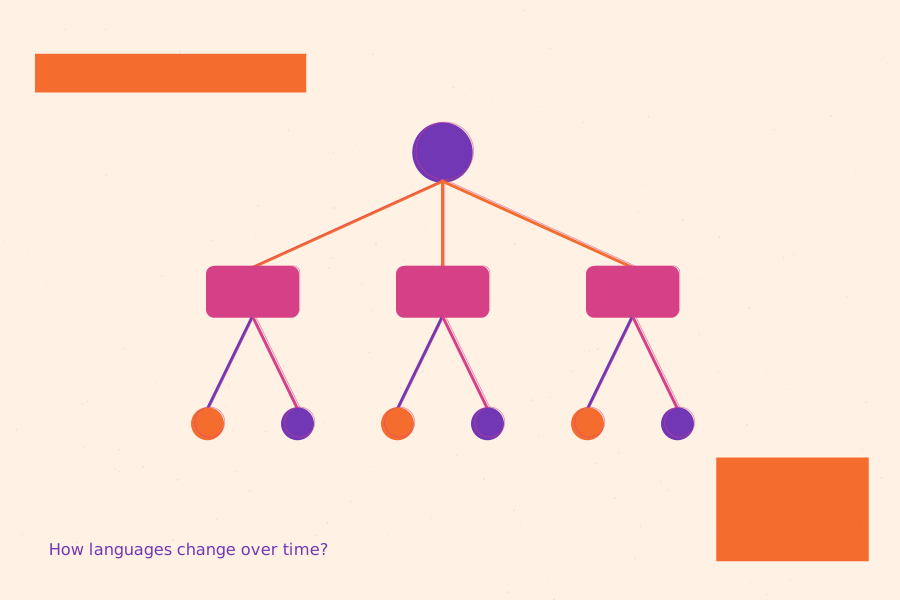
Languages change as speakers transmit and reshape patterns across generations and situations. Sound, word meaning, grammar, and vocabulary can all shift, while communities vary in how quickly and visibly those shifts take hold.
3 min read↗
Learning languages · Guide
There is no single reliable timeline for learning a language: the answer depends on what you mean by “learn,” your starting point, practice, and opportunities to use it. Define a task and track what you can do over time.
4 min read↗

Languages of the world · Guide
UNESCO describes approximately 7,000 languages as still in use, within 8,324 documented languages. These figures count different things, so the larger total should not be mistaken for the number of languages currently used.
3 min read↗
Speaking & storytelling · Guide
A five-minute speech often falls around 600–750 words at a steady 120–150 words per minute, but delivery style and pauses change the total. Rehearse aloud to find your own workable draft length.
3 min read↗
Writing & work · Guide
Adapt writing by changing the context, vocabulary, detail, and format that readers need, while keeping the facts and intended meaning steady. Start from a real reader task and check whether the draft supports it.
3 min read↗