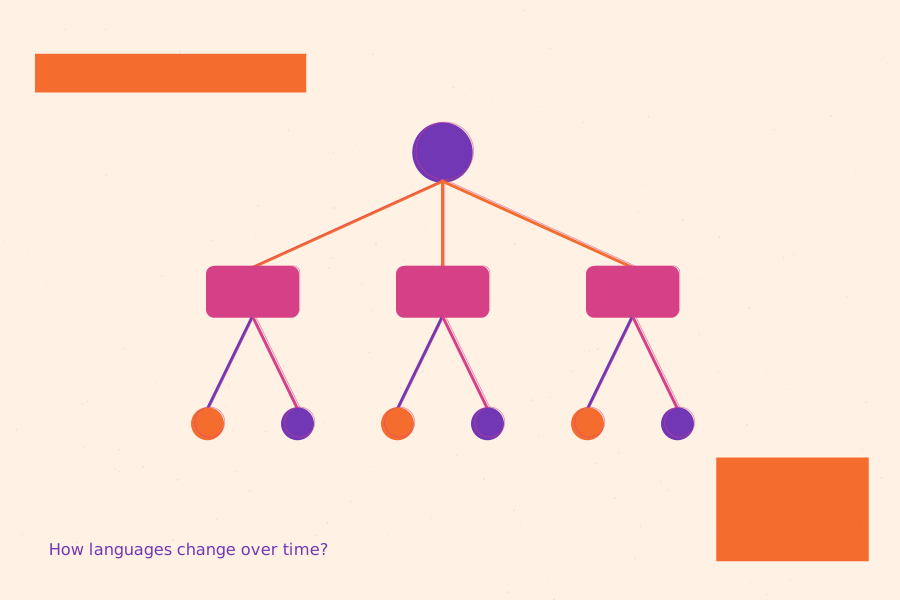
Languages change over time because people transmit them through use, and each generation encounters language in varied settings. Pronunciations, word meanings, grammar patterns, and vocabulary can all shift. A change may spread through a community, remain limited to a group, or compete with an older pattern. Linguists study both language variation and how patterns differ across time. [1]
Change begins as variation
At a given moment, speakers may use more than one form for the same variable. A choice can vary by region, activity, relationship, or other social context. Variation is not automatically evidence of change: two options can coexist for a long time. But a new pattern that becomes more common in a community may be part of a change in progress.
Sociolinguists compare language use at different times, an approach known as real-time analysis. When older recordings, writing, or other records are available, they can be compared with later evidence. Another method compares speakers of different ages at the same time, called apparent-time analysis. It can suggest change, but it depends on assumptions about how people’s language use develops and remains stable. [1]
Change can touch different parts of language
Sound change may alter how a vowel or consonant is pronounced. A word can also gain a new meaning or lose an older one. Grammar patterns shift as speakers use forms in new ways, and vocabulary grows or falls out of use. These processes do not have to move together; a language can change in one area while other patterns remain recognizable.
Some changes spread gradually, with different speakers using competing variants. Others become visible in new words or constructions. Writing may preserve older conventions even as everyday speech shifts, so a spelling system can give an incomplete picture of current pronunciation. Language change is not simply a matter of new slang replacing old words.
A worked example with evidence
Suppose a researcher notices two pronunciations of a word ending in “-ing” in a fictional neighborhood. To test whether the less formal-sounding variant is increasing, the researcher records consenting speakers in more than one age group and conversational setting, then counts each possible occurrence of both variants. The comparison needs the total opportunities for each form; raw counts alone could mislead if one group produced many more “-ing” words. This mirrors the principle that variation analysis must account for all possible tokens. [1]
The researcher could then compare those proportions across age groups and settings. If younger speakers use one variant more often, that is a clue, not proof of a permanent community-wide shift. A later sample or records from an earlier period could help check the interpretation. This is an invented example of a method, not a report of research findings.
People help changes travel
Speakers encounter language from family, peers, school, work, media, and other communities. A form may carry associations with a group or situation, which can affect whether people adopt it, avoid it, or use it selectively. Social meaning is one reason a form’s spread cannot be explained by sound patterns alone.
People also learn new vocabulary throughout life and adjust how they speak in different settings. A community’s language is therefore not a frozen object handed down unchanged. It is a set of shared patterns continually used and interpreted by people. This does not mean every individual controls the direction of change; patterns emerge through many interactions.
Study change without calling it decay
Calling a new form “wrong” or saying a language is deteriorating confuses change with evaluation. A form may be inappropriate for a particular assignment or audience, but that is a social judgment about context. Linguistic analysis asks what speakers use, how forms are patterned, and how those patterns develop.
If you want to observe change, choose one feature and define what counts as each variant. Collect examples from comparable contexts, include every opportunity for the form to occur, and note when the evidence was gathered. Then distinguish your observation from your explanation. That process makes a claim about change testable and keeps one striking example from standing in for a whole language.