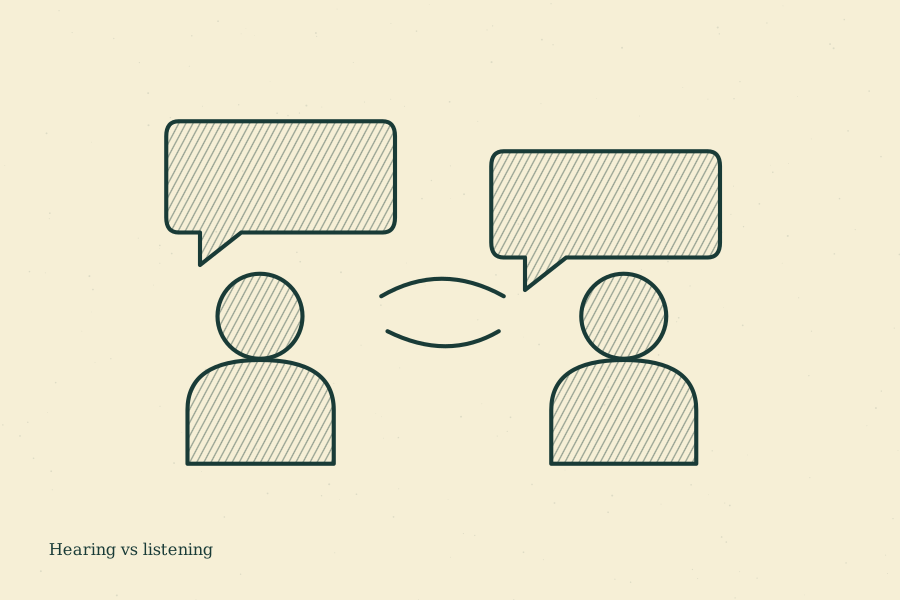
Hearing vs listening is the difference between perceiving sound and attending to what it means. Hearing is the sensory arrival of sound; listening includes focus, interpretation, and a response to a message. In ordinary speech the words often overlap, but the distinction is useful when asking why a conversation was missed or misunderstood.
Sound arrives; attention does work
A person can hear a sentence without following it. You may notice a coworker speaking while mentally planning your reply, then realize you missed the request. The sound reached you, but your attention was elsewhere. Conversely, a listener may attend closely and still misunderstand an unfamiliar term or a vague instruction. Listening is active, but it is not infallible.
Communication material describes barriers such as divided attention, limited concentration, and distorted listening, in which a person recalls or reshapes information inaccurately. These examples show why hearing a message does not guarantee that it was understood. [1]
A simple distinction, not a judgment
The distinction is descriptive, not a way to label someone as careless. People’s attention shifts, the setting can be noisy, and the message itself may be difficult to follow. A speaker who is interrupted or unclear can make listening harder. The useful question is what happened in this exchange and what would help clarify it.
Plain-language guidance frames clarity around a specific audience and whether that audience understands the content. In a conversation, the equivalent is to check whether the listener and speaker share the same meaning, rather than assuming that sound alone carried the message. [2]
Worked example: the missed instruction
In this fictional example, Sam is told, “Please send the revised agenda after Jordan confirms the room.” Sam hears the sentence while closing another task, remembers “send the agenda,” and emails the draft immediately. The problem is not simply that Sam heard or did not hear. The condition—wait for Jordan’s confirmation—was not retained.
A repair could be: “Let me check: I’ll send the revised agenda once Jordan confirms the room.” The speaker can answer, “Yes,” or correct the sequence. The listener has turned an uncertain memory into a checkable summary. If the instruction matters, the speaker can also make the condition prominent: “Wait for Jordan’s room confirmation, then send the revised agenda.”
The example is invented, but the method works broadly: identify the action, any condition or deadline, and the person responsible. Repeat those parts in your own words and invite correction.
Listening includes interpretation
Words do not arrive with every implication labeled. A phrase such as “soon” might mean later today to one person and later this week to another. Listening includes noticing when a term needs a shared definition. Ask, “When you say soon, are you thinking today or later this week?” That question addresses meaning, not hearing ability.
Listening also involves deciding how to respond. You may acknowledge, ask for detail, summarize, or request repetition. None of those moves requires pretending certainty. Saying “I heard the first part but missed the time” is more useful than guessing.
Try a short listening reset
For a low-stakes practice, ask a partner to give a two-part instruction, such as “Put the blue folder by the door after you scan the form.” Listen without preparing a reply. Then state the action and its sequence in your own words. Ask your partner to confirm or correct one element. Switch roles and make the second instruction include a condition.
This exercise is not a test of hearing. It practices attention and checking. A practical next step at work or home is to use the same reset when a request includes a sequence, deadline, or exception: pause, summarize the action and condition, and confirm the details that matter.