Inside language · Guide
A pidgin and a creole are language varieties shaped by contact, but the familiar distinction is whether a variety becomes a community’s first language. The histories and present-day forms are more varied than a simple two-step formula.
3 min read↗
Writing & work · Guide
Plain language puts the reader’s task and needed information first. These examples show how to replace vague, noun-heavy, or indirect wording with specific actions while keeping the meaning and necessary conditions intact.
3 min read↗
Poetry & spoken word · Guide
A beginner-friendly poetry prompt gives you a small starting point, not a formula for a finished poem. Try an object, a sound, a remembered place, or a deliberate constraint, then revise one concrete choice.
3 min read↗
Words & meaning · Guide
Polysemy occurs when one word has several related meanings. Examples such as the different uses of “branch” show how a shared idea connects meanings, while context selects the one a speaker intends.
3 min read↗
Words & meaning · Guide
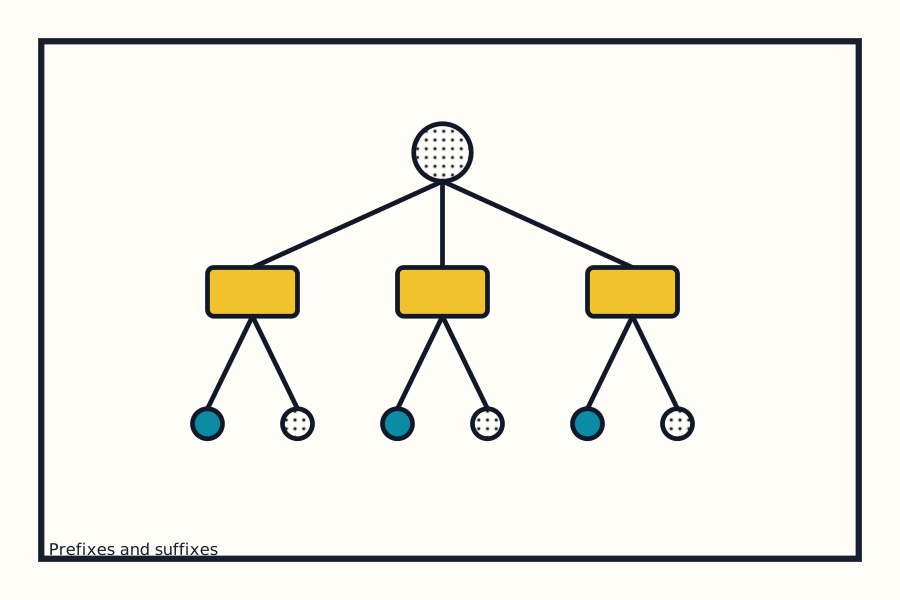
Prefixes attach before a base and suffixes attach after it; both are affixes that add meaning or grammatical information. Learn to spot their position, see how order matters, and practise building and checking words.
3 min read↗

English & grammar · Guide
The past simple places an event in a finished past time; the present perfect connects a past event to now. Learn to choose between them by checking whether the time period is complete and what the listener needs to know.
4 min read↗
Everyday communication · Guide
Reflective listening responds to the meaning or feeling a speaker has expressed, then checks whether you understood. A reflection is brief and open to correction; it does not require advice, a matching story, or a claim to know exactly how someone feels.
4 min read↗
Poetry & spoken word · Guide
Repetition in poetry repeats a sound, word, phrase, or line to build rhythm, emphasis, connection, or change. Learn how to make a repeated phrase develop instead of merely recur.
3 min read↗
Speech & sound · Guide
English speech rhythm comes from patterns of prominence and grouping, not from giving every word equal weight or forcing a fixed beat. Practise with a short sentence and vary what you emphasize.
3 min read↗

Languages of the world · Guide
A right-to-left writing direction describes how a script’s lines typically progress across a page; it does not describe a language’s grammar or the direction of every symbol. Learn the page direction, letter joining, and mixed text as separate features.
3 min read↗

Languages of the world · Guide
Romance languages are a branch of the Indo-European family descended from varieties of Latin. They include Spanish, French, Portuguese, Italian, and Romanian, among others, but shared ancestry does not make them interchangeable.
2 min read↗
Inside language · Guide
Semantics describes conventional meaning; pragmatics studies how context shapes what a speaker or signer communicates. Separating the two helps distinguish a sentence’s literal content from a request, implication, or context-dependent reference.
3 min read↗
English & grammar · Guide
A semicolon links closely related independent clauses; a colon points forward from a complete clause to an explanation, example, or list. Use clause structure and the intended relationship to choose.
3 min read↗
Speech & sound · Guide
Sentence stress is the shifting prominence of words in a spoken phrase. It helps listeners track new, contrasting, or corrected information; the same sentence can sound different when its focus changes.
4 min read↗
Speech & sound · Guide
Shadowing is a pronunciation practice in which you speak along with a short recording, following its timing and sound. Learn how to choose a clip, repeat it deliberately, and check what changed.
3 min read↗
Words & meaning · Guide
A simile compares unlike things using a cue such as like or as; a metaphor describes one thing as another. Both create connections, but they frame the comparison differently.
3 min read↗
English & grammar · Guide
Simple, compound, and complex describe how clauses are arranged. Learn to identify independent and dependent clauses, see how the patterns shape emphasis, and revise a short passage with a practical clause-counting exercise.
3 min read↗

Languages of the world · Guide
Simplified and traditional Chinese refer to different character forms used in written Chinese. The choice depends on audience and publishing convention; it does not by itself identify a spoken language or a person’s ability.
3 min read↗