English & grammar · Guide
An independent clause has a subject, a verb, and a complete thought; a dependent clause has a subject and verb but relies on another clause. Recognizing the difference helps you connect ideas and punctuate them clearly.
3 min read↗

Learning languages · Guide
Intensive reading means slowing down to examine a short text; extensive reading means reading more for overall meaning and continuity. Both are useful when the task fits the text and your current goal.
3 min read↗

Poetry & spoken word · Guide
Internal rhyme occurs when words rhyme within a single line, rather than only at line endings. These original examples show several placements and offer a simple method for testing whether an internal rhyme serves the poem’s voice.
3 min read↗

Speech & sound · Guide
Intonation is the pattern of pitch movement across a phrase or sentence. In English it can help signal a statement, question, emphasis, or attitude, but context and word stress shape its interpretation.
4 min read↗

Languages of the world · Guide
Irish and Scottish Gaelic are closely related but distinct Goidelic languages. They share historical roots and some recognizable features, yet each has its own standard forms, pronunciation patterns, and living communities.
3 min read↗

Multilingual lives · Guide
No. There is no single sign language shared by everyone. Communities use many distinct sign languages, and visual communication across language boundaries may require adaptation, an interpreter, or an agreed shared method.
3 min read↗

English & grammar · Guide
Its shows that something belongs to or is associated with it; it’s means it is or it has. Expand the contraction in context to decide, then check that the sentence still says what you intend.
3 min read↗

Multilingual lives · Guide
Language and identity connect through the ways people express belonging, history, relationships, and personal style. Names, accents, word choices, and sign languages can carry social meaning, but no single feature tells you everything about a person.
4 min read↗

Multilingual lives · Guide
Language attrition is a change in how readily someone can access or use a language, often as their opportunities to use different languages shift. It does not automatically mean a language has been erased; identify the skill and setting that changed before deciding what to practice.
4 min read↗

Learning languages · Guide
Build a small, repeatable language environment at home by connecting everyday activities to comprehensible input, retrieval, and brief speaking. Immersion is sustained contact with a language, not a requirement to understand everything.
4 min read↗

Learning languages · Guide
A workable study plan assigns recurring time to input, active recall, and communication tasks, then adjusts from evidence of what you can do. Start with a week you can repeat, not an idealized timetable.
3 min read↗
Inside language · Guide
Language revitalization is community-directed work to strengthen a language’s learning, use, and transmission. It can include teaching, everyday conversation, creative practice, and rebuilding access to settings where the language belongs.
3 min read↗
English & grammar · Guide
In the common meanings, lay takes an object: someone lays something down. Lie means to recline or rest without an object. The past tense of lie is lay, which is why the pair causes confusion.
3 min read↗

English & grammar · Guide
Use fewer with plural countable things and less with amounts treated as a whole. The choice depends on how the noun is framed, so a quick test is to ask whether you can count the items one by one.
4 min read↗

Speech & sound · Guide
Linking sounds are transitions that let neighboring words flow together, especially when one word ends in a consonant and the next begins with a vowel. A short listen-and-repeat exercise can make these transitions easier to hear and use.
3 min read↗

Words & meaning · Guide
Literal language uses words in a direct sense; figurative language invites a comparison, image, or conventional meaning beyond that direct sense. Context helps distinguish the two and reveals what a figure contributes.
3 min read↗
Translation & interpreting · Guide
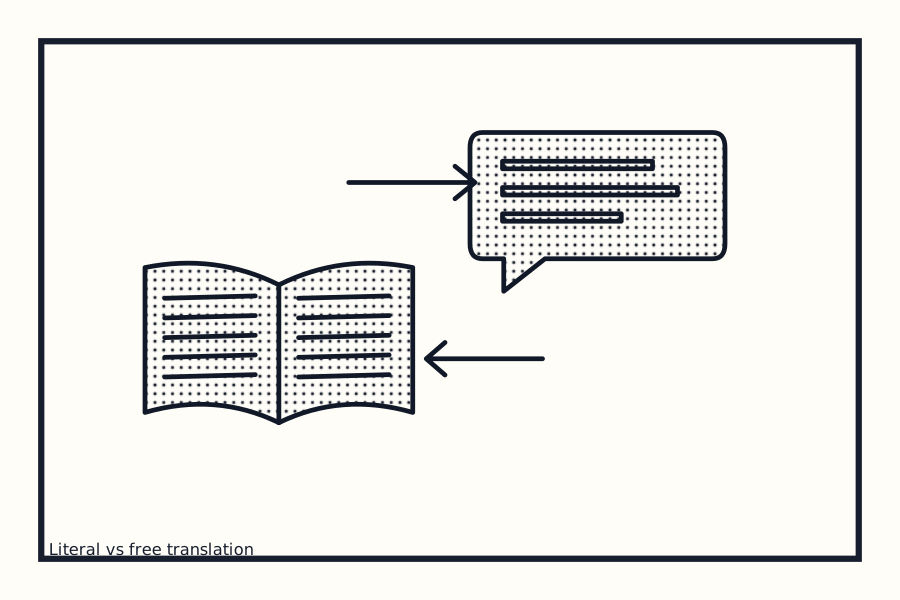
Literal translation stays close to the source wording and structure; free translation gives greater priority to the intended meaning and effect. A fictional announcement demonstrates how to choose a level of freedom without losing essential details.
3 min read↗

Words & meaning · Guide
A loanword is a word English has taken from another language and made part of its own vocabulary. Borrowing can preserve a sound, shift a meaning, or reshape pronunciation and spelling as speakers use the word.
3 min read↗