Languages of the world · News & context
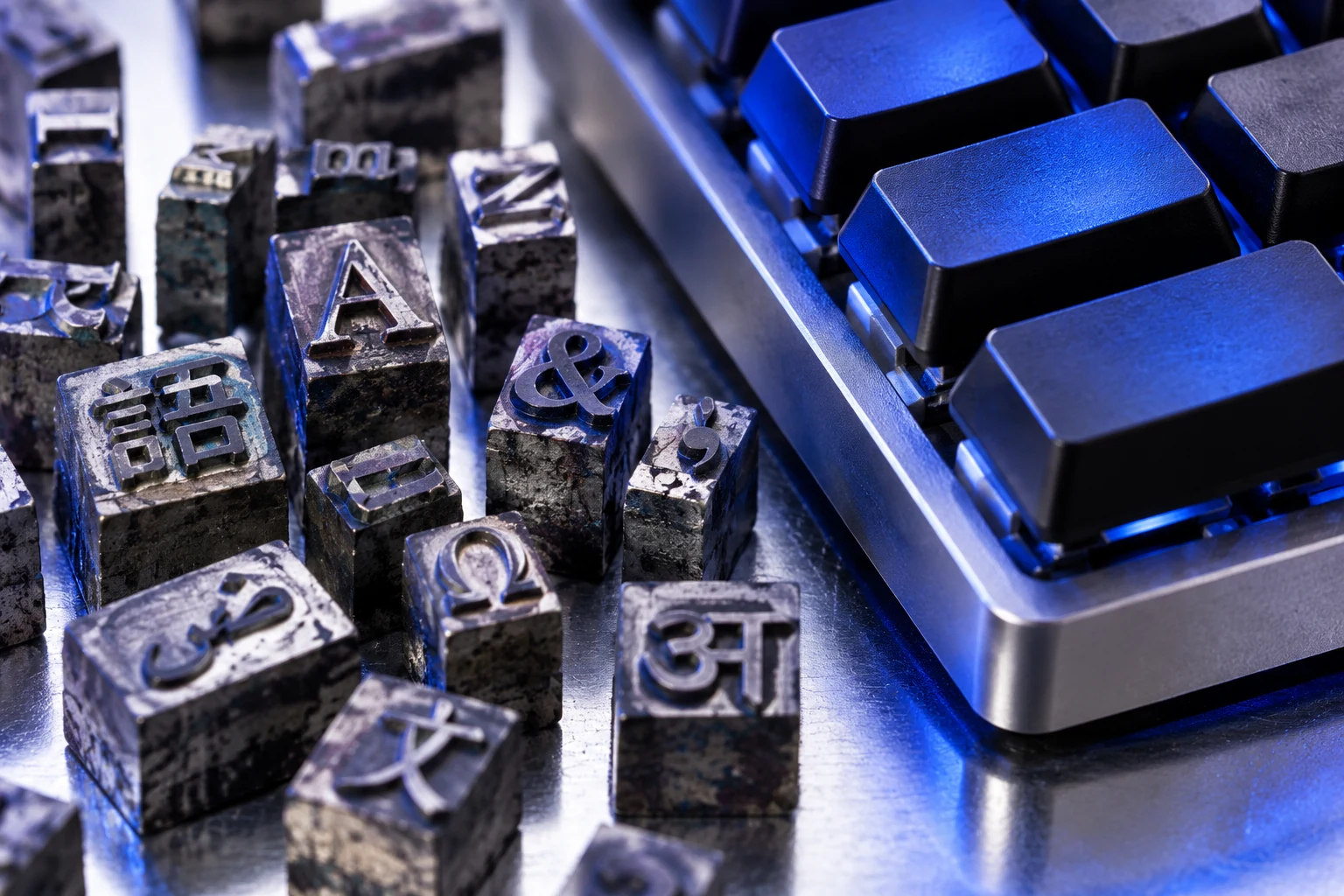
A UNESCO report on the 20–23 October Unicode Technology Workshop describes work on encoding, fonts, rendering and keyboards. Each solves a different part of digital language support; the Global Survey overview is planned for 2027.
Coverage 29 Oct 2026↗
Languages of the world · News & context
UNESCO’s 9 October 2026 announcement invited States Parties and other groups to organize events from 1–31 October for the International Day of the Intangible Cultural Heritage, observed on 17 October. The invitation did not establish that any particular group participated.
Coverage 1 Oct 2026↗
Languages of the world · News & context
The European Commission’s 2026 highlights span literature, fairs, festivals, quizzes and language cafés. These formats make a language encounter social and hands-on; a hypothetical event can borrow their variety without claiming to reproduce official activities.
Coverage 26 Sep 2026↗
Languages of the world · Guide
An alphabet generally represents consonants and vowels with separate letters; a syllabary assigns signs to syllables or similar spoken units. Many real writing systems combine principles, so the distinction is a useful guide rather than a rigid divide.
3 min read↗
Languages of the world · Guide
Arabic dialects are regional spoken varieties with their own patterns of pronunciation, vocabulary, and grammar. They coexist with Modern Standard Arabic, which is used in many formal and cross-regional settings; there is no single dialect that everyone speaks.
3 min read↗
Languages of the world · Guide
Germanic languages form a branch of the Indo-European family, including English, German, Dutch, and the North and West Germanic languages. Their shared history explains some patterns, but not a single modern grammar or vocabulary.
3 min read↗
Languages of the world · Guide
Hangul is the Korean writing system, designed around letters that represent speech sounds and grouped into syllable blocks. Its visual structure helps readers see how consonants and vowels combine, but it still takes practice to read fluently.
3 min read↗
Languages of the world · Guide
Hindi and Urdu are closely related varieties with much shared everyday speech, but they use different standard scripts and draw on different formal vocabularies. The gap becomes clearer in writing and elevated registers than in ordinary conversation.
3 min read↗
Languages of the world · Guide
Hiragana and katakana are two Japanese kana syllabaries that represent the same set of basic moraic units in different forms. Their uses differ by convention, and Japanese writing also commonly includes kanji and Latin letters.
3 min read↗
Languages of the world · Guide
UNESCO describes approximately 7,000 languages as still in use, within 8,324 documented languages. These figures count different things, so the larger total should not be mistaken for the number of languages currently used.
3 min read↗
Languages of the world · Guide
Irish and Scottish Gaelic are closely related but distinct Goidelic languages. They share historical roots and some recognizable features, yet each has its own standard forms, pronunciation patterns, and living communities.
3 min read↗
Languages of the world · Guide
Mandarin and Cantonese are distinct spoken languages or varieties within the broader Chinese language landscape, with differences in pronunciation, vocabulary and usage. Shared writing practices do not make spoken conversation automatically interchangeable.
3 min read↗
Languages of the world · Guide
Modern Standard Arabic is a formal shared standard used widely in writing and prepared public speech, while Arabic dialects are regional varieties used heavily in everyday conversation. Most learners should choose based on the situations they want to handle.
3 min read↗
Languages of the world · Guide
In Statista Research Department’s 2026 tabulation of Ethnologue, the four largest total-speaker estimates are English, Mandarin Chinese, Hindi, and Spanish. The order and numbers depend on counting total speakers rather than first-language speakers.
3 min read↗
Languages of the world · Guide
Hindi in Devanagari script is the official language of the Union, and English continues in specified Union official uses under law. States may adopt one or more languages for their own official purposes; scheduled-language recognition is a separate category.
3 min read↗
Languages of the world · Guide
The United Nations has six official languages: Arabic, Chinese, English, French, Russian, and Spanish. They support interpretation in meetings and translation of documents, though particular language arrangements can vary by setting.
2 min read↗
Languages of the world · Guide
A right-to-left writing direction describes how a script’s lines typically progress across a page; it does not describe a language’s grammar or the direction of every symbol. Learn the page direction, letter joining, and mixed text as separate features.
3 min read↗
Languages of the world · Guide
Romance languages are a branch of the Indo-European family descended from varieties of Latin. They include Spanish, French, Portuguese, Italian, and Romanian, among others, but shared ancestry does not make them interchangeable.
2 min read↗