Words & meaning · Guide
A collocation is a familiar pairing of words, such as “make a choice” or “heavy rain.” Learn how repeated patterns shape natural phrasing, how they differ from idioms, and how to practice them in your own writing.
4 min read↗

Inside language · Guide
A constructed language is a language deliberately designed by one or more people. It may be created for a story, an artistic project, experimentation, or communication, and its design can be developed in many different ways.
3 min read↗
Words & meaning · Guide
A euphemism replaces a word or phrase that may feel offensive, painful, or socially awkward with a less direct expression. Learn how context shapes its effect, and practise choosing language that is clear as well as considerate.
3 min read↗
Inside language · Guide
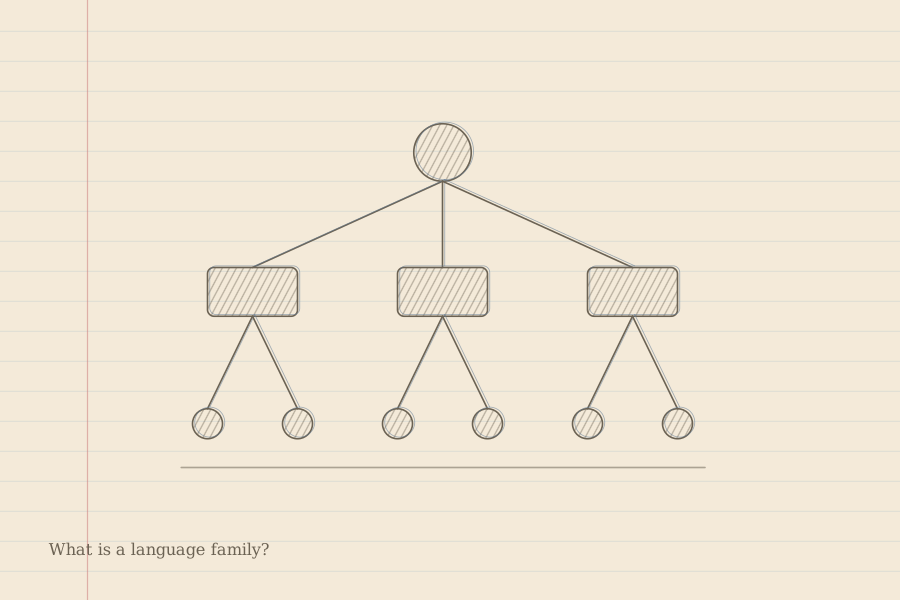
A language family is a group of languages understood to descend from a shared ancestral language. Linguists infer relationships from systematic correspondences, while recognizing that contact, borrowing, and incomplete records complicate the evidence.
3 min read↗
Inside language · Guide
A lingua franca is a language used as a shared means of communication by people who do not share the same first language. The role depends on a particular setting and does not make the language everyone’s native language.
3 min read↗

Inside language · Guide
A morpheme is the smallest systematic pairing of form with meaning or grammatical function. It may stand alone or attach to another piece, and identifying one requires a recurring pattern rather than a visual slice of a word.
3 min read↗
Speaking & storytelling · Guide
A narrative arc is the path of change a story traces from an opening situation through rising pressure toward an outcome. A small original example distinguishes that arc from a plot summary and offers a simple way to map its turning point.
4 min read↗
Words & meaning · Guide
A neologism is a newly created or newly adopted word or expression, including a fresh meaning for an existing form. Some neologisms remain temporary; others spread and become ordinary vocabulary through use.
3 min read↗
Words & meaning · Guide
A phrasal verb combines a verb with a particle, often an adverb or preposition, to form a unit of meaning. The whole expression may be literal, figurative, or dependent on context.
3 min read↗
Words & meaning · Guide
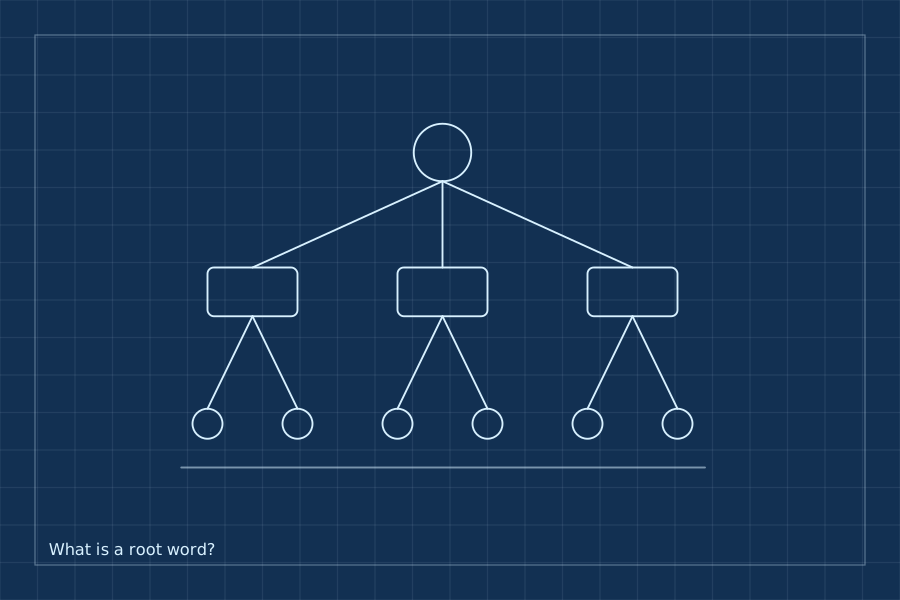
A root is the smallest base in a word to which further word parts can attach. Learn how roots differ from stems and everyday standalone words, then practise analyzing a familiar English example without confusing modern structure with word history.
3 min read↗
Poetry & spoken word · Guide
A sonnet is a fourteen-line poem traditionally shaped by a rhyme scheme, meter, and a turn in thought. Learn its common patterns and draft a compact argument with a clear shift.
3 min read↗
Poetry & spoken word · Guide
A stanza is a grouped set of lines in a poem, often separated from other groups by a blank line. Learn how grouping shapes pace and meaning, then test a stanza break in an original short poem.
3 min read↗
Words & meaning · Guide
An acronym is an abbreviation formed from the initial letters of a multiword name and pronounced as a word. Learn how it differs from other shortened forms, then design and test a fictional example for clarity.
3 min read↗
Inside language · Guide
An agglutinative language builds words by attaching recognizable pieces, often with each affix contributing a relatively consistent meaning or grammatical function. The label describes a tendency, not a perfect category.
3 min read↗
Inside language · Guide
An endangered language is one whose continued use and transmission face risk, especially when fewer children learn it or everyday settings for speaking it shrink. The label describes a changing social situation, not a defect in the language.
3 min read↗
Words & meaning · Guide
An idiom is an expression whose conventional meaning cannot be fully worked out from the literal meanings of its individual words. Context and community knowledge help listeners interpret it.
3 min read↗
Words & meaning · Guide
An oxymoron pairs words with contradictory or sharply incongruous meanings, such as an invented “patient hurry.” See how tension between the words creates a compact effect, and use a revision exercise to make your own precise.
3 min read↗
Poetry & spoken word · Guide
Anaphora is the deliberate repetition of a word or phrase at the start of successive lines or clauses. Learn how its placement creates emphasis, rhythm, and expectation, with an original example and a revision exercise.
3 min read↗