A language family is a group of languages that linguists classify as related through descent from a common ancestor. The ancestor may be documented or reconstructed from patterns shared by its descendants. Family membership describes historical relationship; it does not rank languages, measure similarity in every feature, or tell speakers what their language should become. [1]
Relationship by descent
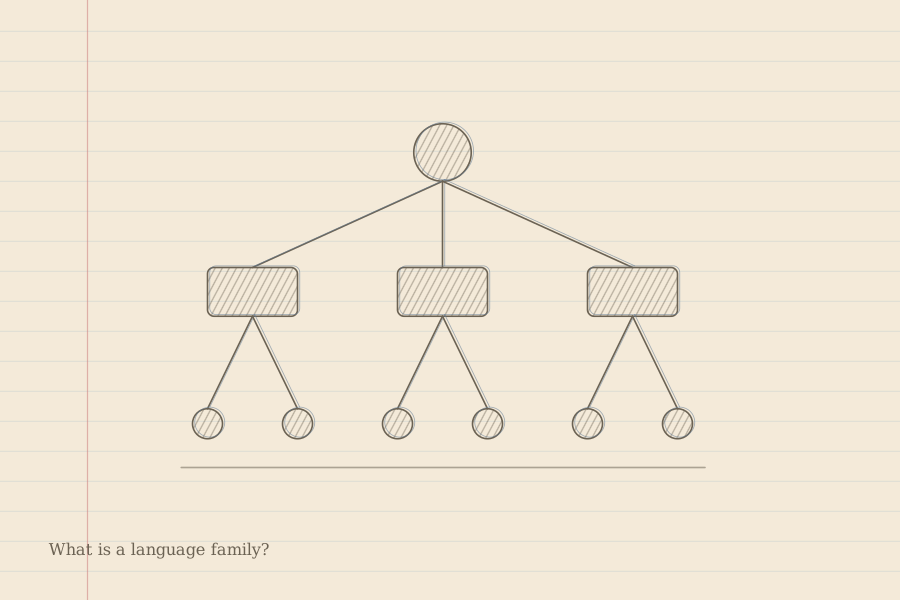
Languages change over generations. When communities become separated, their speech can develop along different paths. If later languages preserve systematic correspondences in vocabulary and grammar, those patterns can support the hypothesis that they descend from an earlier language. A family tree is a model of that historical relationship, not a map of present-day borders or a claim that languages split in one tidy moment.
A useful analogy is related branches from an older trunk, with an important limit: language histories include contact, migration, and change at different rates. The tree captures inheritance, but it may not represent every influence. Languages can borrow words and constructions from neighbors without becoming members of the same family.
How linguists look for evidence
Researchers compare forms across languages and look for regular sound correspondences. A resemblance between two words is not enough: similar forms can arise by chance, borrowing, or shared sounds that are common across languages. A stronger case involves recurring patterns across many words, along with grammatical evidence that fits the proposed relationship.
For languages without extensive historical records, linguists can use comparative methods to infer features of an ancestral language. Those reconstructions are evidence-based hypotheses, not recordings of an actual speaker. The method depends on systematic patterns, and conclusions may be revised as documentation or analysis improves. [1]
Family is not the same as similarity
Two related languages may look quite different after long periods of change, while unrelated languages can share features through contact or coincidence. A language family is therefore not a ranking of closeness for everyday understanding. Nor does family membership mean that one language is a “simpler” or more complete version of another.
The label also does not decide who belongs to a community or what a language is called by its speakers. Linguistic classification is one tool for describing historical relationships. Community names, identities, and language practices matter in their own right and are not reducible to a family-tree diagram.
A worked reasoning example
Imagine an invented dataset, not a real pair of languages. Language A has words with initial /p/ where Language B regularly has /f/, and the same correspondence appears in a dozen basic vocabulary items. Suppose related grammatical endings also line up in a consistent way. One matching word would be weak evidence; a recurring correspondence across unrelated meanings is more persuasive. The analyst would then ask whether borrowing or chance explains the pattern, and compare still more forms.
This reasoning illustrates how to evaluate a family claim without memorizing a list. Make columns for the forms, identify repeated sound relationships, and check whether the pattern recurs in core vocabulary and grammatical material. Mark uncertain cases, and avoid treating spelling similarity as proof. The exercise demonstrates a method only; it does not establish a real historical relationship.
Use the label with care
When you encounter a family name, ask what kind of evidence supports the classification and what the label is intended to explain. It can help organize historical comparison, but it cannot stand in for the histories of the communities who speak the languages. It also cannot tell you whether two particular people will understand each other; that depends on the languages, varieties, exposure, and context involved.
Language families make linguistic history visible by showing patterns of inheritance across generations. Their most useful message is methodological: relationships are inferred from converging evidence, while individual languages remain complete systems in their own right.