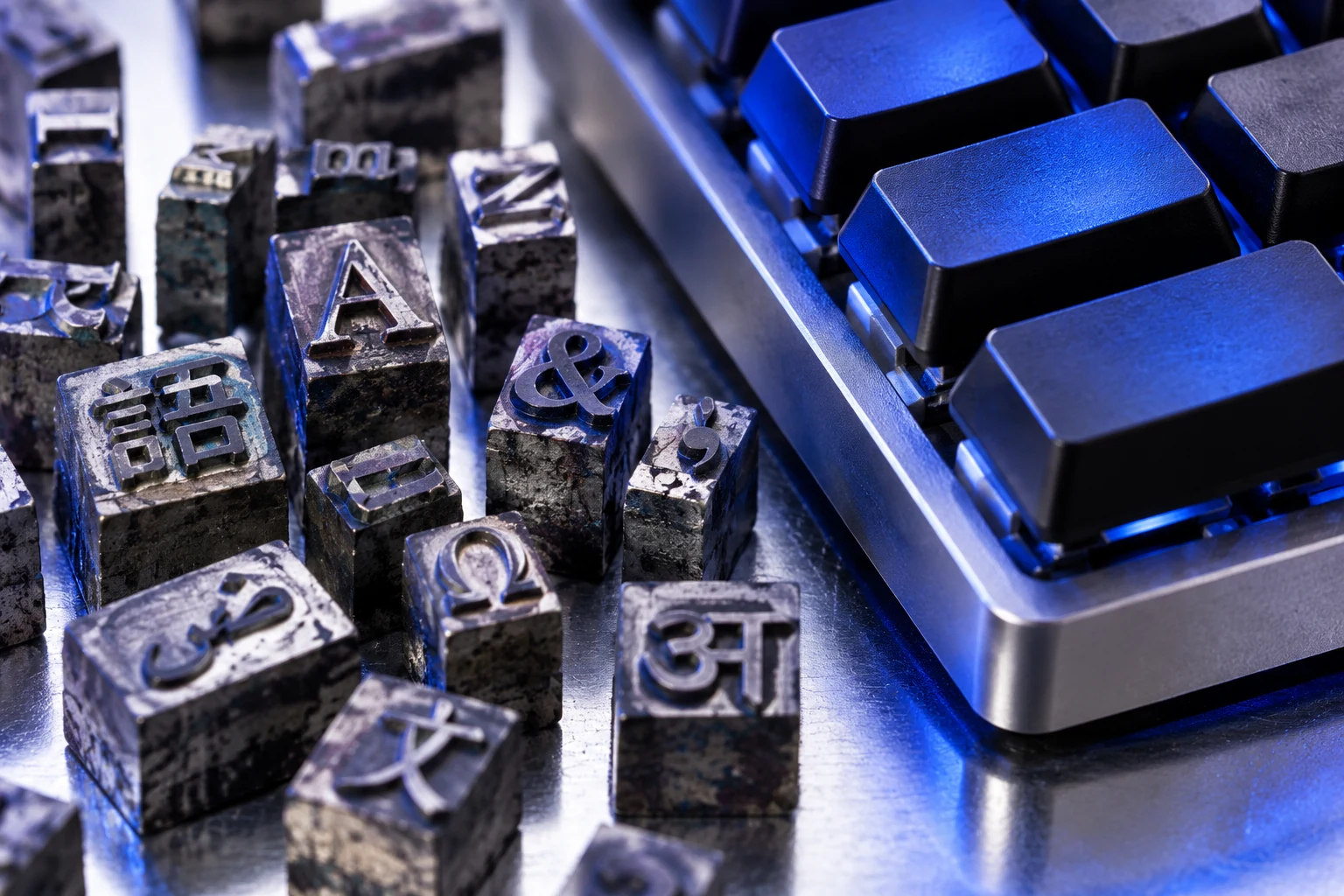
A writing system is a set of conventions for representing language in visible marks. The language is not the script: one language can be written in more than one script, and a script can be adapted to write different languages. A writing system may represent sounds, syllables, meaningful word parts, or combinations of these, so there is no single template behind all writing.
Start by asking what the marks represent
An alphabet generally uses symbols for individual consonants and vowels, though the fit between letters and sounds differs across languages. An abjad primarily represents consonants, while readers use knowledge of the language to interpret vowels that may be unwritten or marked in particular ways. A syllabary uses signs for syllables or mora-sized units. A morphographic system uses signs associated with meaningful units, often alongside sound-based clues.
These categories are useful starting points, not airtight boxes. Real systems can combine principles, and spelling conventions can preserve historical forms or distinguish words that sound alike. It is better to ask how a particular script works than to assume that every character has one fixed sound or one fixed meaning.
Script does not determine grammar
Changing the script does not necessarily change a language’s spoken grammar. The linguistics text gives Mongolian as an example of a language written in Cyrillic and traditional Mongolian script; it also explains that language users can understand spoken language regardless of which script records it. [1]
Writing is important, but literacy is not a requirement for having a language or a grammar. The same source notes that some languages do not have writing systems and that signed languages such as ASL and LSQ do not have written forms in the conventional sense. [1] This distinction helps avoid treating speech or signing as incomplete merely because it is not represented by a familiar alphabet.
A worked example: design a tiny code
To see the categories in action, invent a spoken language for a fictional island and give it four syllables: pa, mi, tu, and ko. A syllabary could assign one unique sign to each whole syllable. An alphabet could use separate signs for p, m, t, k, a, i, u, and o, then combine them to spell the same syllables. A morphographic design could instead assign a mark to a fictional word meaning “harbor,” even if that word has several syllables.
This is a deliberately simple model, not a claim about a real script. Try extending it: decide how the system records a question, a pause, or a new word. Then ask whether your symbol stands for a sound, a spoken chunk, or meaning. That question reveals the design choice more clearly than the visual shape alone.
Read without guessing from appearance
When you meet an unfamiliar script, separate three questions: what language is being written, what unit the symbols represent, and which spelling conventions affect pronunciation. A shape that looks like a picture may function as a conventional sign; a character that represents a syllable is not necessarily a miniature picture of its meaning.
For a practical next step, choose a short sample from a language you are studying and mark each visible unit according to its role: sound, syllable, word part, or punctuation. If the role is unclear, consult a source that explains that specific writing system. This small annotation exercise replaces vague visual impressions with a testable description.