Words & meaning · Guide
Both acronyms and initialisms are built from initials, but the usual distinction is how people pronounce them: as a word or as individual letter names. Apply that test, then introduce either form with enough context for readers.
3 min read↗
Words & meaning · Guide
Ambiguity in language arises when a word, phrase, or sentence supports more than one interpretation. Identifying whether the source is lexical, structural, or contextual helps clarify meaning without treating every uncertainty as an error.
3 min read↗
Words & meaning · Guide
Denotation is a word’s basic reference or dictionary meaning; connotation is the feeling, association, or social meaning it can carry. Reading both layers helps writers choose precise words and notice how language affects an audience.
3 min read↗
Words & meaning · Guide
False friends are words in different languages that look or sound alike but have different meanings. Context, part of speech, and example sentences help prevent a familiar-looking word from steering you toward the wrong interpretation.
3 min read↗
Words & meaning · Guide
Formal and informal language are styles suited to different relationships, purposes, and situations. They exist on a continuum, and effective style shifting means adapting to context without treating one variety as universally correct.
3 min read↗
Words & meaning · Guide
Homophones share pronunciation; homonyms is a broader or differently defined label for words linked by sound, spelling, or both. Because terminology varies, use the clearer terms homophone and homograph when the distinction matters.
3 min read↗
Words & meaning · Guide
Homophones are words that sound alike but have different meanings, and often different spellings. Examples such as “flower” and “flour” show why listeners use context and writers use sentence structure to resolve sound-based ambiguity.
3 min read↗

Words & meaning · Guide
Context helps listeners select among possible word senses, understand what a speaker refers to, and infer what an utterance is doing. A word’s available meanings and the situation together shape an interpretation.
3 min read↗
Words & meaning · Guide
A metaphor compares unlike things by describing one as another; an idiom is a conventional expression with a figurative meaning. A phrase can be both metaphorical and idiomatic.
3 min read↗
Words & meaning · Guide
Literal language uses words in a direct sense; figurative language invites a comparison, image, or conventional meaning beyond that direct sense. Context helps distinguish the two and reveals what a figure contributes.
3 min read↗
Words & meaning · Guide
A loanword is a word English has taken from another language and made part of its own vocabulary. Borrowing can preserve a sound, shift a meaning, or reshape pronunciation and spelling as speakers use the word.
3 min read↗
Words & meaning · Guide
Polysemy occurs when one word has several related meanings. Examples such as the different uses of “branch” show how a shared idea connects meanings, while context selects the one a speaker intends.
3 min read↗
Words & meaning · Guide
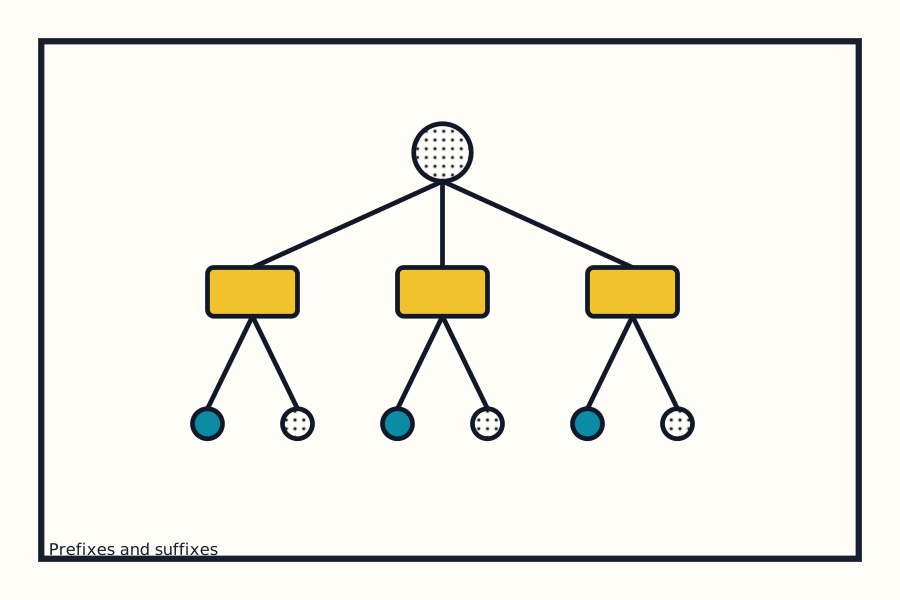
Prefixes attach before a base and suffixes attach after it; both are affixes that add meaning or grammatical information. Learn to spot their position, see how order matters, and practise building and checking words.
3 min read↗
Words & meaning · Guide
A simile compares unlike things using a cue such as like or as; a metaphor describes one thing as another. Both create connections, but they frame the comparison differently.
3 min read↗
Words & meaning · Guide
Slang is informal vocabulary associated with social use and group identity; jargon is specialized language used within a field or activity. A term can serve both roles, so its audience and purpose matter more than the word alone.
3 min read↗
Words & meaning · Guide
Synonyms have similar meanings; antonyms express a contrast. Neither label guarantees that words are interchangeable in every sentence, so compare meaning, tone, context, and the kind of opposition involved before revising.
3 min read↗
Words & meaning · Guide
A collocation is a familiar pairing of words, such as “make a choice” or “heavy rain.” Learn how repeated patterns shape natural phrasing, how they differ from idioms, and how to practice them in your own writing.
4 min read↗
Words & meaning · Guide
A euphemism replaces a word or phrase that may feel offensive, painful, or socially awkward with a less direct expression. Learn how context shapes its effect, and practise choosing language that is clear as well as considerate.
3 min read↗