Poetry & spoken word · Guide
Alliteration repeats consonant sounds, often at the beginnings of nearby words. These examples show how it can create momentum, texture, or emphasis, and how to revise a line so the sound supports its meaning.
3 min read↗
Poetry & spoken word · Guide
Assonance repeats vowel sounds in nearby words, whether those sounds appear at the beginning, middle, or end. These examples and a short revision exercise show how vowel echoes can connect images and shape a line’s tone.
3 min read↗
Poetry & spoken word · Guide
Consonance in poetry is the repetition of similar consonant sounds, often within or at the ends of nearby words. Learn how it differs from alliteration and rhyme, then use an original line exercise to tune a poem’s texture.
3 min read↗

Poetry & spoken word · Guide
Free verse is not governed by a fixed meter or established form; blank verse is unrhymed poetry with a regular meter, most commonly iambic pentameter. Both can sound natural, but only blank verse keeps a consistent metrical pattern.
3 min read↗
Poetry & spoken word · Guide
Analyze a poem by noticing what it says, how its language and form shape that meaning, and where your reading is supported by details. A worked example shows how to move from observation to interpretation.
3 min read↗
Poetry & spoken word · Guide
Choose a performance poem by testing its voice, shape, emotional range, and fit for the room. A short read-aloud exercise can reveal whether the poem gives you something clear and sustainable to communicate.
3 min read↗
Poetry & spoken word · Guide
Useful poetry feedback describes a reader’s specific response and connects it to the poem’s choices. A clear process can help you offer observations and questions without taking control of the writer’s revision.
3 min read↗
Poetry & spoken word · Guide
Memorize a poem by learning its sequence in small sections, recalling each section without looking, and connecting the sections through meaning and sound. Practice recovery points so a missed word does not erase the whole poem.
3 min read↗
Poetry & spoken word · Guide
A useful poetry workshop has a clear purpose, a manageable sequence, and agreements that make participation and feedback easier. This guide offers a practical plan, including a short writing exercise and adaptable options.
3 min read↗
Poetry & spoken word · Guide
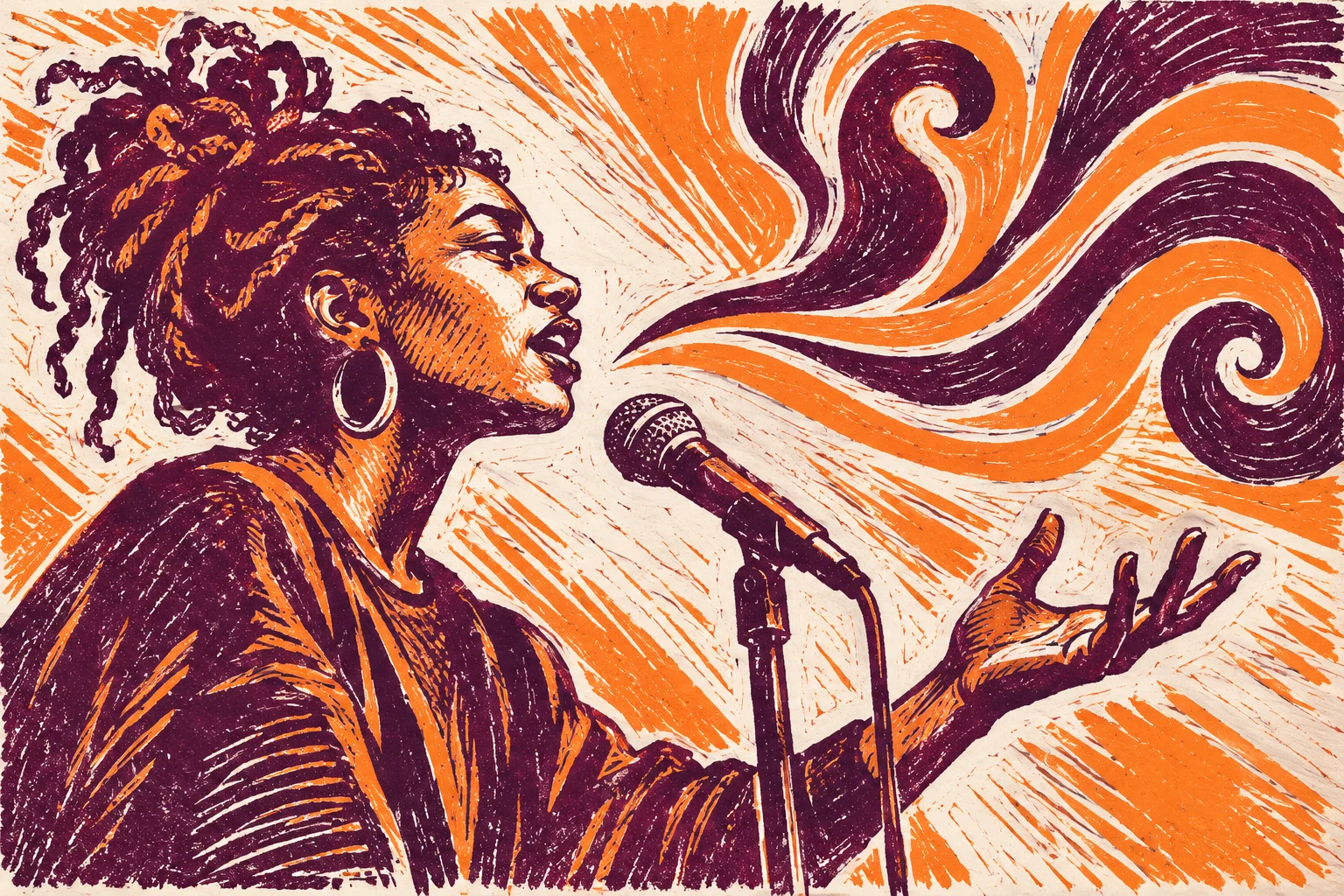
Perform a poem by understanding its speaker and turns, then making clear choices about pace, pauses, emphasis, and volume. Practice aloud so the voice supports the poem’s meaning instead of competing with it.
3 min read↗
Poetry & spoken word · Guide
Write a haiku by focusing on a brief, concrete moment and choosing a few vivid details. Traditional Japanese haiku and English-language syllable-count exercises are related but not identical practices.
3 min read↗
Poetry & spoken word · Guide
An acrostic poem spells a word or name with the first letters of its lines. Choose a meaningful anchor, give each line an independent image, and revise so the poem reads as more than a list.
4 min read↗
Poetry & spoken word · Guide
To write spoken word poetry, start with a moment you can picture, find the question or tension inside it, and build lines that sound natural aloud. Read each draft aloud and revise for breath, clarity, and emphasis.
4 min read↗
Poetry & spoken word · Guide
Iambic pentameter is a line organized around five iambs, each moving from a weaker syllable to a stronger one. Learn how to hear its approximate pulse, scan an original example, and account for natural variations in speech.
3 min read↗
Poetry & spoken word · Guide
Imagery is language that represents sensory experience, including sight, sound, smell, taste, and touch. Learn to replace general labels with specific details that let a reader encounter a scene.
3 min read↗
Poetry & spoken word · Guide
Internal rhyme occurs when words rhyme within a single line, rather than only at line endings. These original examples show several placements and offer a simple method for testing whether an internal rhyme serves the poem’s voice.
3 min read↗
Poetry & spoken word · News & context
Kilkenny County Council Arts Office announced a partnership with the Kilkenny Observer to publish weekly selections from the 2026 Kilkenny Poetry Broadsheet. The annual broadsheet is in its 26th year and features writers from across County Kilkenny.
Coverage 19 Oct 2026↗
Poetry & spoken word · News & context
On 22 October 2026, Poetry Ireland announced applications to its Partnership Scheme for poetry activities taking place from 1 January to 30 June 2027. The application window closes on 15 November at 5pm; applying is not receiving an award.
Coverage 22 Oct 2026↗