Everyday communication · Guide
Open ended questions examples
Open-ended questions invite a fuller answer than a yes-or-no reply, often by asking how, what, or which. Use them to explore a topic, while keeping the question focused and easy to answer.
Find an answer, follow a curiosity, or begin something new. Practical guides and current stories across twelve subjects.
Open-ended questions invite a fuller answer than a yes-or-no reply, often by asking how, what, or which. Use them to explore a topic, while keeping the question focused and easy to answer.
The Oxford comma is the comma before the final conjunction in a list of three or more items. See how it can clarify grouping, when a house style may omit it, and how to test a sentence for ambiguity.
Paraphrasing restates a specific passage at similar detail; summarizing condenses a larger section to its main ideas. This guide shows how to choose between them and practice both accurately.
The past perfect marks an event as earlier than another past reference point. Form it with had plus a past participle, and use it when the order of past events needs to be clear.
A phoneme is a contrastive sound category in a language; allophones are its context-dependent phonetic realizations. Compare meaning contrasts, distribution, and phonetic similarity before deciding whether sounds belong to one category or two.
Phonetics studies the physical production, perception, and properties of linguistic signals; phonology studies how a language organizes sound patterns into categories and rules.
A pidgin and a creole are language varieties shaped by contact, but the familiar distinction is whether a variety becomes a community’s first language. The histories and present-day forms are more varied than a simple two-step formula.
Plain language puts the reader’s task and needed information first. These examples show how to replace vague, noun-heavy, or indirect wording with specific actions while keeping the meaning and necessary conditions intact.
A beginner-friendly poetry prompt gives you a small starting point, not a formula for a finished poem. Try an object, a sound, a remembered place, or a deliberate constraint, then revise one concrete choice.
Polysemy occurs when one word has several related meanings. Examples such as the different uses of “branch” show how a shared idea connects meanings, while context selects the one a speaker intends.
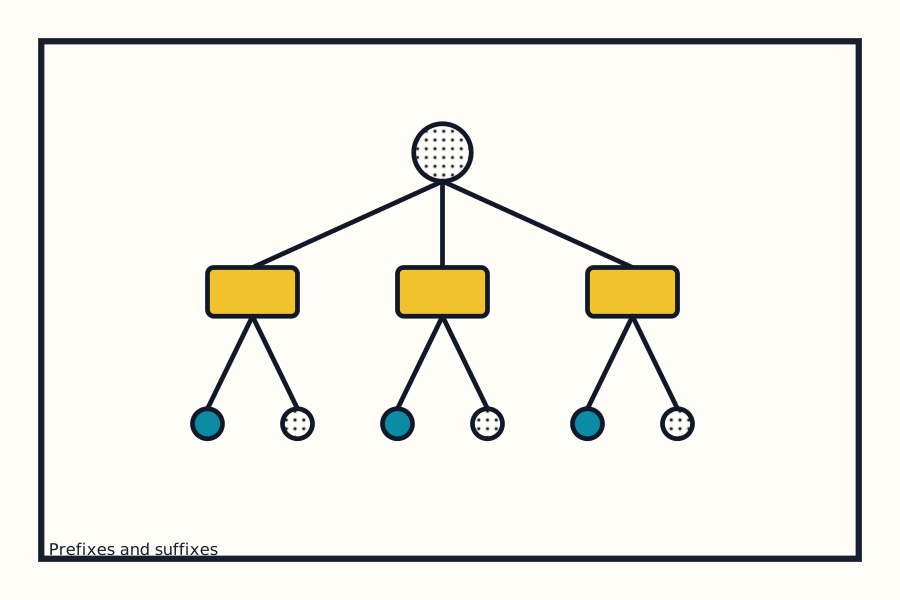
Prefixes attach before a base and suffixes attach after it; both are affixes that add meaning or grammatical information. Learn to spot their position, see how order matters, and practise building and checking words.
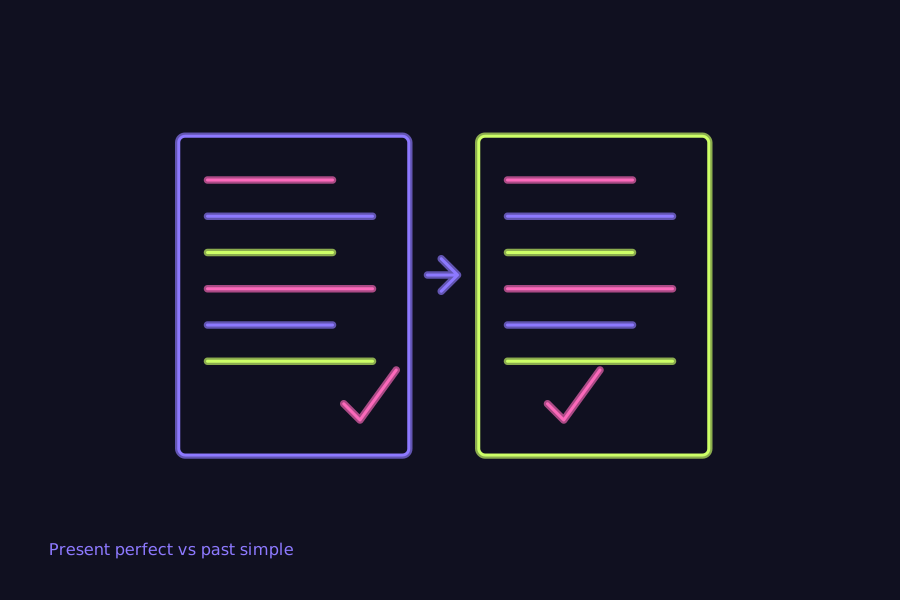
The past simple places an event in a finished past time; the present perfect connects a past event to now. Learn to choose between them by checking whether the time period is complete and what the listener needs to know.
Reflective listening responds to the meaning or feeling a speaker has expressed, then checks whether you understood. A reflection is brief and open to correction; it does not require advice, a matching story, or a claim to know exactly how someone feels.
Repetition in poetry repeats a sound, word, phrase, or line to build rhythm, emphasis, connection, or change. Learn how to make a repeated phrase develop instead of merely recur.
English speech rhythm comes from patterns of prominence and grouping, not from giving every word equal weight or forcing a fixed beat. Practise with a short sentence and vary what you emphasize.
A right-to-left writing direction describes how a script’s lines typically progress across a page; it does not describe a language’s grammar or the direction of every symbol. Learn the page direction, letter joining, and mixed text as separate features.
Romance languages are a branch of the Indo-European family descended from varieties of Latin. They include Spanish, French, Portuguese, Italian, and Romanian, among others, but shared ancestry does not make them interchangeable.
Semantics describes conventional meaning; pragmatics studies how context shapes what a speaker or signer communicates. Separating the two helps distinguish a sentence’s literal content from a request, implication, or context-dependent reference.