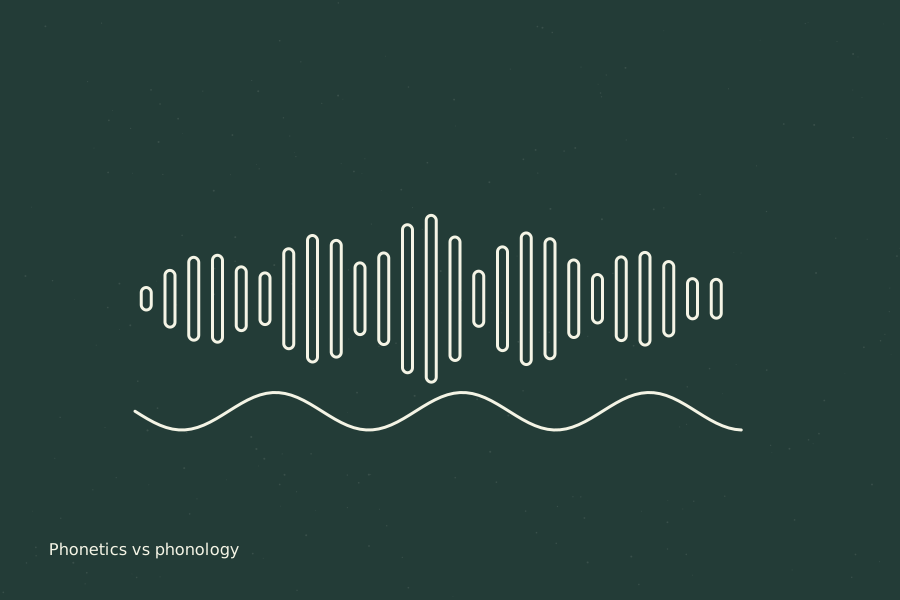
Phonetics studies the physical properties of linguistic signals: how sounds are produced, perceived, and shaped acoustically. Phonology studies how a particular language organizes those sounds into categories and patterns. In short, phonetics asks what is happening in the signal and the body; phonology asks which differences matter in a language system.
One sound, two kinds of question
Imagine hearing two slightly different pronunciations of a sound. A phonetician might ask where the tongue is, whether vocal folds vibrate, or how the sound wave changes. A phonologist might ask whether the language treats those pronunciations as two distinct categories or as predictable variants of one category.
The distinction is about the question, not two separate worlds. Phonological categories are inferred from patterns in real speech, while phonetic description helps identify what speakers physically produce. Linguistics texts describe phonemes as abstractions that cannot be directly observed in the signal; researchers look at patterns among the phones to determine how they relate [1].
A familiar English example
In many varieties of English, the /t/ in “writer” may sound like a flap [ɾ], while the /t/ in “return” may be aspirated [tʰ]. The exact forms vary across speakers and contexts. A phonetic account describes the difference between [ɾ] and [tʰ]; a phonological account can ask whether they are separate phonemes or conditioned realizations of /t/ in these environments.
The textbook gives related English examples and explains that a flap may occur between vowels when the next syllable is unstressed, while an aspirated [tʰ] occurs in other environments [1]. A learner can use this example to see why two physically different sounds do not automatically represent two different words or categories.
Contrastive difference or predictable variation?
A useful phonological test is whether changing one sound while keeping the rest of a word the same can distinguish words in that language. If it can, the contrast is likely meaningful there. If two pronunciations appear in predictable environments and do not distinguish words, they may be analyzed as allophones of one phoneme. The evidence depends on the language and the pattern being studied.
Do not assume that a distinction absent in one language is absent everywhere. Languages organize sound contrasts differently. The same physical difference might distinguish words in one language and be predictable variation in another. A language’s categories are not a measure of its complexity or value.
A paper-and-voice exercise
Use an invented mini-data set: write “writer,” “return,” and “attack,” then listen to several speakers pronounce them. Make two columns: “what I can hear or observe” and “what pattern might explain it.” In the first, note an audible flap or a puff of air if present. In the second, propose a possible relationship between the variants and their positions.
Then look for a counterexample or another context before deciding. A small set can suggest a pattern but cannot establish how every English speaker talks. This exercise keeps phonetics close to observable details and phonology focused on a proposed system.
Why the distinction matters
Pronunciation teaching can use phonetic detail to help a learner notice how a sound is made, while phonological insight can explain which contrasts help distinguish words in the language being learned. A pronunciation dictionary may use phonemic notation to represent categories, while a detailed phonetic transcription can record finer differences. Always check the source’s key and conventions.
The distinction also applies beyond speech with care: linguistics studies signed languages, whose visual and spatial structures are not speech sounds. The broad study of language includes different modalities, so phonetics and phonology should not be used as if every language were spoken [1].