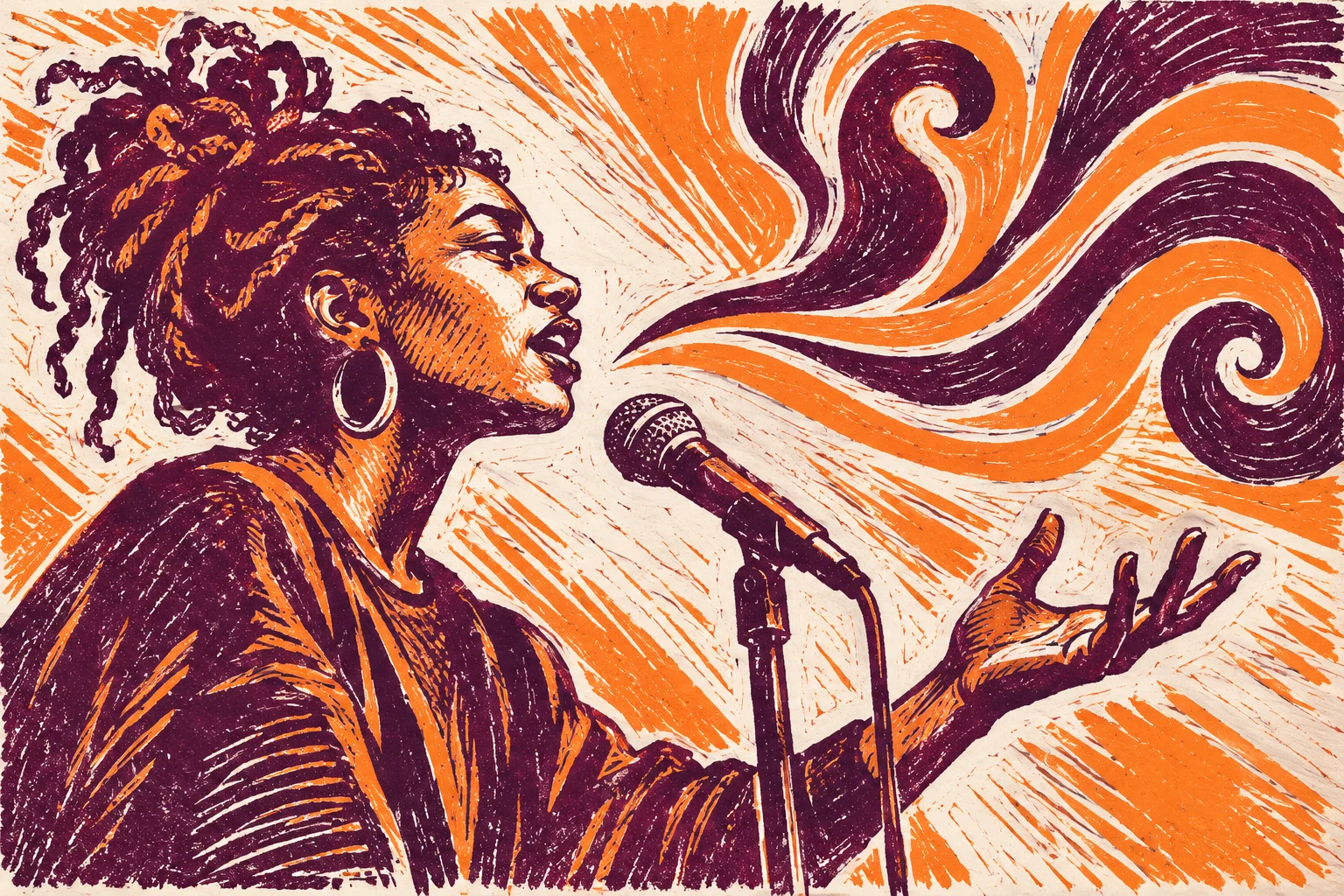
Spoken word poetry is poetry made for the ear and the room as well as the page. A performer’s pacing, emphasis, pauses, and presence help shape how listeners experience the words. The term describes a broad practice rather than one strict structure: a piece may rhyme, use free verse, tell a story, or return to a repeated line.
A poem designed to be heard
On the page, a line break can guide the eye or shape a pause. In performance, the poet can make that pause audible, carry a sentence across a break, or alter the pace to change its force. Spoken word therefore draws on poetic language and oral delivery. It is related to performance poetry, but a piece does not need a particular rhyme scheme or stage format to count as spoken word.
The Academy of American Poets’ glossary describes poetry as a broad form of writing and defines free verse as open-form poetry not governed by an established meter or structure, often influenced by speech rhythms. That range helps explain why spoken word cannot be reduced to one template. [1]
Voice, rhythm, and repetition
A spoken-word poet can use repetition to help listeners recognize an idea as it returns. The glossary defines anaphora as successive phrases or lines beginning with the same words, and a refrain as a phrase or line repeated at intervals. These devices can create a pulse or build an argument when heard aloud. [1]
Consider this original miniature, written for performance: “I carried the map / through rain, through dark, / through one more street.” Read it once evenly. Then read “through” with increasing emphasis each time. The repeated word starts as a list and becomes a measure of persistence. Nothing in the wording changed; the delivery changed what listeners may notice.
Meaning lives in the choices
Performance does not mean theatrical volume at every moment. A quiet line can invite attention; a pause can let an image settle; a faster passage can feel crowded or urgent. These choices should serve the poem’s meaning. A writer can mark possible pauses in a draft, but a useful performance often leaves room to respond to the actual space and audience.
Try a short exercise with a poem of your own. Choose four lines and underline the word that carries the most important turn in each. Read the passage aloud once without emphasis, then again with a pause before each underlined word. Record or ask a listener what changed. If the emphasis makes the meaning less clear, test a different pause or stress. This is practice, not a claim about a tradition or a performer’s biography.
Page and stage inform each other
Spoken word can begin on a page, in rehearsal, or with a phrase discovered aloud. A written draft lets a poet see repeated words, line lengths, and structure; speaking it reveals where breath, stress, or syntax feels awkward. Revision can move in either direction. The poet may change a line break to support the voice, or change the voice to reveal a line’s ambiguity.
The glossary’s entries on line, form, prosody, and voice point to the many choices poets can make in organizing language and sound. Those terms are tools for noticing possibilities, not requirements that every spoken-word poem must satisfy. [1]
Listen without assuming one style
Spoken word includes many voices, languages, subjects, and performance choices. Some pieces address public questions; others focus on intimate memory, humor, sound, or a single image. Don’t assume that every performance must be autobiographical, confessional, political, rhymed, or improvised. A poem’s speaker is also not automatically identical to its author; the Academy’s glossary treats “speaker” as the voice of a poem. [1]
To explore the form yourself, write a short piece around a concrete moment: a bus door opening, a kettle beginning to sing, or a message left unanswered. Read it aloud and notice where your breath naturally pauses. Then revise one line for sound and one for clarity. The aim is to make choices that help a listener experience the poem, not to imitate an assumed style.