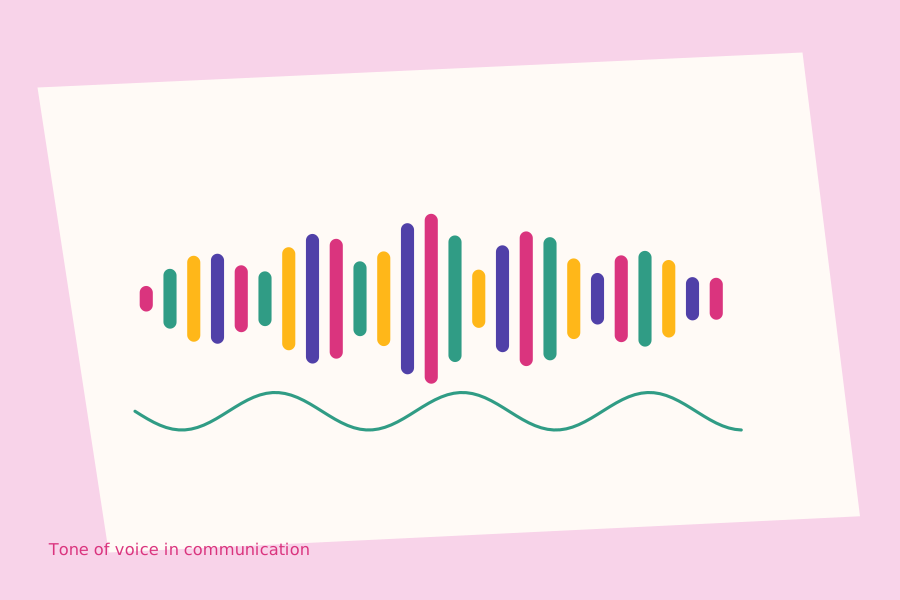
Tone of voice in communication is the sound of how words are delivered: features such as pitch, pace, volume, and vocal variation can shape whether a sentence seems warm, impatient, uncertain, or emphatic. Tone is part of nonverbal communication, but it does not reveal a person’s intention by itself. The same words and vocal quality can be interpreted differently depending on the situation, relationship, and listener. [1]
Words carry content; delivery adds cues
Consider the sentence “That’s a good idea.” Spoken with a lively rise in pitch, it might sound enthusiastic. Delivered quietly and flatly, it could sound restrained, tired, or sarcastic. The words provide the literal statement; the voice adds cues that listeners use to interpret the speaker’s stance. Vocal elements such as pitch, volume, and rate are forms of paralanguage. [1]
These cues work alongside facial expression, gesture, and setting. In a noisy room, a raised voice may simply help someone be heard. During a tense discussion, the same volume might feel forceful. Tone therefore matters, but it cannot be read as a fixed code in which one pitch or speed always means one emotion.
Treat an impression as a hypothesis
A listener may think, “That sounded annoyed,” but that impression is not the same as knowing the speaker felt annoyed. Voice can be ambiguous, and habits, fatigue, attention, or the demands of a setting may affect how someone sounds. Communication references note that nonverbal signals can carry emotional meaning while remaining more ambiguous than words. [1]
A useful distinction is between describing the cue and deciding what it means. “Your answer was quiet and brief” describes what you noticed. “You’re angry with me” assigns an emotion and a cause. If the interpretation affects what you do next, test it: “I heard a short answer and wondered if now is a bad time. Would you rather talk later?” This keeps the conversation open without asking the other person to defend against a conclusion you cannot confirm.
Read the situation as well as the sound
Tone gains meaning in context. A speaker who uses a measured pace during a public reading may be shaping the rhythm for an audience. In a quick planning call, that same pace may leave little room for questions. The listener’s expectations matter too: one person may hear directness as efficiency; another may experience it as abruptness. These are possible readings, not characteristics of whole cultures or fixed rules about how people speak.
If you are unsure, consider the purpose of the interaction, what happened just before the sentence, and whether the speaker’s words and other signals point in the same direction. Nonverbal cues can reinforce, complement, substitute for, or contradict words, so a mismatch is a reason to clarify rather than proof of deception. [1]
Use your voice with a listener in mind
When speaking, choose a delivery that supports your purpose. A clear pace gives listeners time to follow a complex explanation; a little emphasis can show which step matters most. Keep volume appropriate to the room, and leave space after a request for the other person to respond. These are adjustments, not universal rules for sounding professional or kind. Your natural voice, accent, and dialect do not need to be erased for your meaning to count.
For example, imagine you need to tell a collaborator that a draft needs revision. A fast, clipped “We need to talk about this” may make the topic seem more alarming than you intend. Try: “Could we review the opening together? I think the purpose needs to appear earlier.” State the issue directly and use your tone to make the invitation sound like an invitation. If the other person seems unsure, explain the request instead of relying on vocal warmth alone.
A short tone-check exercise
Choose one neutral sentence, such as “I can send that tomorrow,” and say it three ways: as a straightforward commitment, as a hesitant possibility, and as a reassuring response. Notice how changes in pace, emphasis, and pitch affect your impression. Then ask a partner what they heard and compare it with what you intended. The activity demonstrates how delivery shapes interpretation; it does not establish a rule about what a particular voice means in everyday life.
In a real exchange, name the uncertainty gently. “I may be misreading your tone—are you concerned about the deadline, or is there another issue?” If you are the speaker, you can also make intent explicit: “I’m asking because I want to solve this together, not because I’m blaming you.” Words can clarify what vocal cues leave open.