
Writing & work · Guide
Meeting minutes are a concise record of decisions, actions, and essential context, not a transcript. Capture who will do what by when, then circulate the notes while the details are still easy to confirm.
3 min read↗

Poetry & spoken word · Guide
To write spoken word poetry, start with a moment you can picture, find the question or tension inside it, and build lines that sound natural aloud. Read each draft aloud and revise for breath, clarity, and emphasis.
4 min read↗

Poetry & spoken word · Guide
Iambic pentameter is a line organized around five iambs, each moving from a weaker syllable to a stronger one. Learn how to hear its approximate pulse, scan an original example, and account for natural variations in speech.
3 min read↗

Words & meaning · Guide
A metaphor compares unlike things by describing one as another; an idiom is a conventional expression with a figurative meaning. A phrase can be both metaphorical and idiomatic.
3 min read↗

Poetry & spoken word · Guide
Imagery is language that represents sensory experience, including sight, sound, smell, taste, and touch. Learn to replace general labels with specific details that let a reader encounter a scene.
3 min read↗

Multilingual lives · Guide
Inclusive language makes room for people’s identities and circumstances by choosing terms that are accurate, respectful, and suited to context. Ask when a person’s preference is unknown, and revise wording when it excludes someone unnecessarily.
3 min read↗
English & grammar · Guide
An independent clause has a subject, a verb, and a complete thought; a dependent clause has a subject and verb but relies on another clause. Recognizing the difference helps you connect ideas and punctuate them clearly.
3 min read↗

Learning languages · Guide
Intensive reading means slowing down to examine a short text; extensive reading means reading more for overall meaning and continuity. Both are useful when the task fits the text and your current goal.
3 min read↗
Poetry & spoken word · Guide
Internal rhyme occurs when words rhyme within a single line, rather than only at line endings. These original examples show several placements and offer a simple method for testing whether an internal rhyme serves the poem’s voice.
3 min read↗

Speech & sound · Guide
Intonation is the pattern of pitch movement across a phrase or sentence. In English it can help signal a statement, question, emphasis, or attitude, but context and word stress shape its interpretation.
4 min read↗

Languages of the world · Guide
Irish and Scottish Gaelic are closely related but distinct Goidelic languages. They share historical roots and some recognizable features, yet each has its own standard forms, pronunciation patterns, and living communities.
3 min read↗

Multilingual lives · Guide
No. There is no single sign language shared by everyone. Communities use many distinct sign languages, and visual communication across language boundaries may require adaptation, an interpreter, or an agreed shared method.
3 min read↗

English & grammar · Guide
Its shows that something belongs to or is associated with it; it’s means it is or it has. Expand the contraction in context to decide, then check that the sentence still says what you intend.
3 min read↗

Multilingual lives · Guide
Language and identity connect through the ways people express belonging, history, relationships, and personal style. Names, accents, word choices, and sign languages can carry social meaning, but no single feature tells you everything about a person.
4 min read↗

Multilingual lives · Guide
Language attrition is a change in how readily someone can access or use a language, often as their opportunities to use different languages shift. It does not automatically mean a language has been erased; identify the skill and setting that changed before deciding what to practice.
4 min read↗

Learning languages · Guide
Build a small, repeatable language environment at home by connecting everyday activities to comprehensible input, retrieval, and brief speaking. Immersion is sustained contact with a language, not a requirement to understand everything.
4 min read↗

Learning languages · Guide
A workable study plan assigns recurring time to input, active recall, and communication tasks, then adjusts from evidence of what you can do. Start with a week you can repeat, not an idealized timetable.
3 min read↗
Inside language · Guide
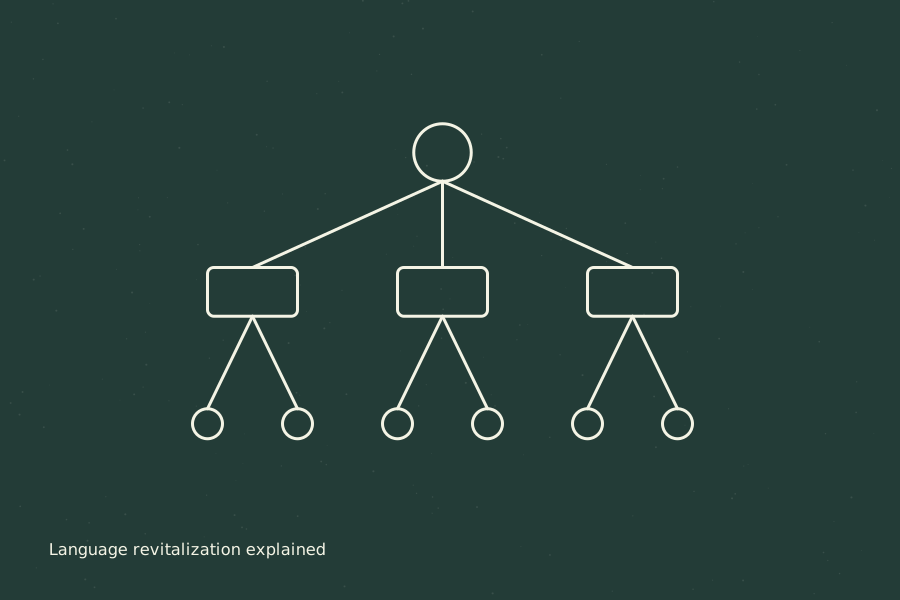
Language revitalization is community-directed work to strengthen a language’s learning, use, and transmission. It can include teaching, everyday conversation, creative practice, and rebuilding access to settings where the language belongs.
3 min read↗