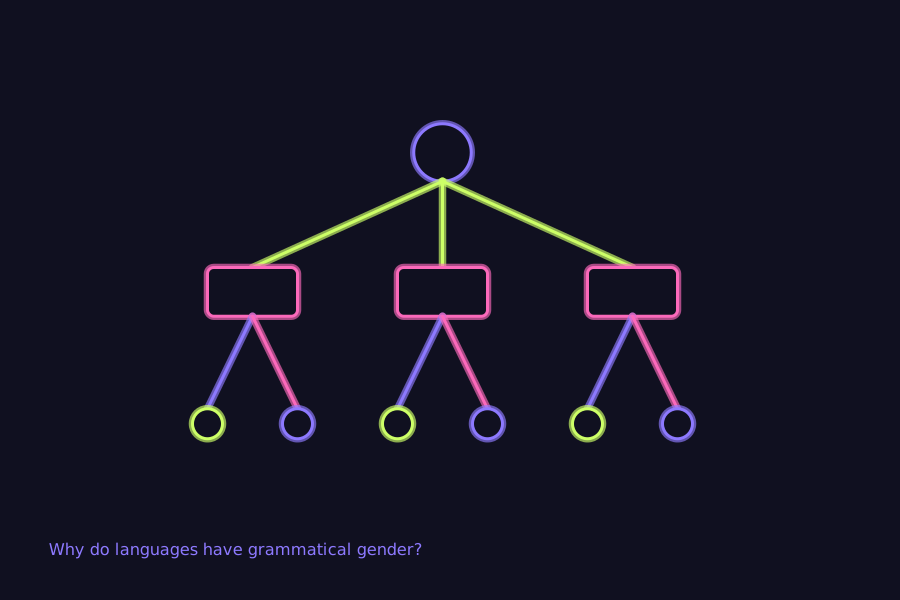
Languages have grammatical gender because their grammar organizes some nouns into classes that can shape agreement on related words. In French, for example, nouns such as chat (“cat”) and abeille (“bee”) belong to different grammatical genders, which are reflected in the forms of accompanying words. These categories do not necessarily describe biological sex. Other languages classify nouns in different ways, including systems beyond masculine and feminine. [1]
Gender is a grammatical category
In a language with grammatical gender, a noun belongs to a category, and other parts of the sentence may show agreement with it. That agreement can appear on articles, adjectives, or other elements. A speaker learns which forms go together as part of the language’s patterns, much as speakers learn plural marking or word order.
The word gender can invite assumptions from everyday discussions of people. In grammar, it refers to a system of noun classification. The labels masculine and feminine may be used for classes, but the classification of a noun is not a claim about the sex or identity of the thing it names. A bee can belong to a grammatically feminine class, for instance, without the category making a biological statement.
French makes agreement visible
The textbook examples “le petit chat” and “la petite abeille” show the French masculine forms le and petit with chat, and feminine la and petite with abeille. The changes on the determiner and adjective reflect the noun’s grammatical class. The contrast helps illustrate agreement: words that belong together display related forms. [1]
This is a pattern of French, not a rule for every language. Even within a language, the forms speakers use may depend on number, syntax, or other grammatical features. To learn a particular language’s system, follow a reliable description of that language and attend to the forms that occur together rather than assuming a direct translation from English.
Classification can work in other ways
Some languages have noun classes that divide nouns into categories not called masculine and feminine. The linguistics text describes Bantu languages with multiple classes, including a class for humans, and notes that agreement can reflect class membership. Algonquian languages including Cree and Anishinaabemowin distinguish animate and inanimate nouns. The details differ across languages, so “gender” should not be treated as a universal two-class template. [1]
A system’s categories may seem predictable in some areas and arbitrary in others. Classification can group people, animals, objects, or other meanings according to language-specific patterns. The point is not that every noun class maps neatly to a real-world category. It is that speakers know the grammatical patterns and use them consistently within their language.
A worked agreement exercise
Here is a small invented exercise in English using labels rather than new grammar claims. Imagine a fictional language with two noun classes, A and B. Class A nouns take the article “ka” and adjective ending “-i”; Class B nouns take “ta” and “-u.” If the class A noun for “lamp” is “meka,” then “ka meka rani” might mean “the bright lamp,” with “rani” as the class A form of “bright.” The exercise stipulates these patterns solely to make agreement visible.
Now replace “lamp” with a class B noun for “basket,” say “sotu.” The matching phrase would use “ta” and the class B adjective form, “tanu sotu ran u” if the invented adjective’s B form were “ranu.” Keep the parts legible: “tanu sotu ranu.” The practical task is to track which forms change when the noun changes, not to infer that lamps or baskets possess a gender in the human sense.
Why keep the label clear?
Grammatical gender can affect how learners choose articles, adjectives, or pronouns in languages that mark agreement. It can also be interesting to compare how different languages organize meaning. But one language’s category system should not be treated as a ranking or as evidence that its speakers think about the world in one uniform way.
When writing about a specific language, name the language and describe the actual agreement pattern. If discussing how a class relates to people’s gender, distinguish grammatical marking from social identity and note the language’s accepted forms. The next useful step is to examine a few noun phrases from a trustworthy grammar, underline the noun, and circle the forms that agree with it.