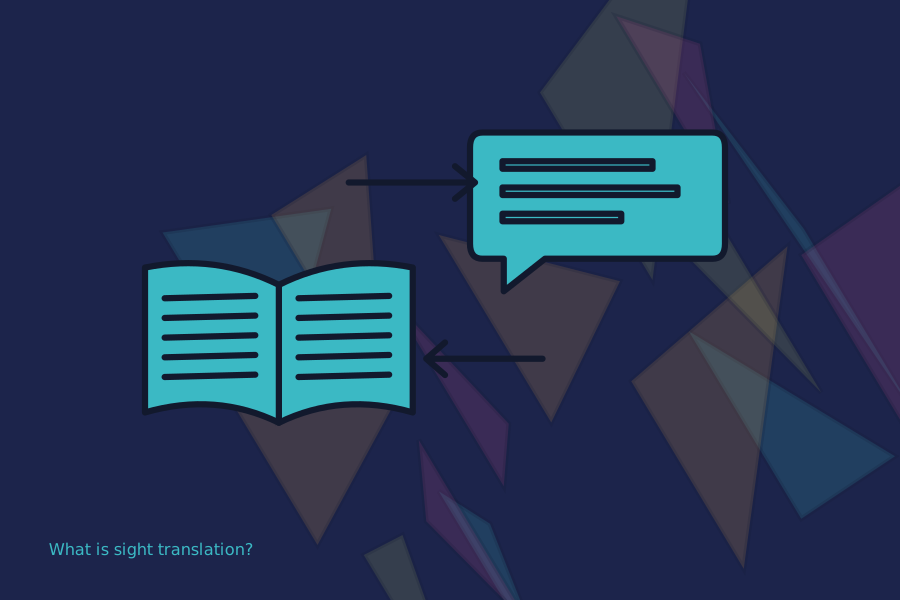
Sight translation is the oral rendering of a written text into another language while the language professional reads it. The source arrives on a page or screen, but the result is spoken aloud. That makes it different from ordinary written translation, whose result is another written text, and from interpreting, which starts with spoken language. The distinction matters because a document can look simple yet contain dates, conditions, technical terms, or layout cues that need careful attention.
A page goes in; speech comes out
A sight translation usually happens in real time or with limited preparation. The reader scans the source, identifies its structure and key information, then speaks a version in the target language. Depending on the setting, the person may read directly from the document, pause to review a section, or ask for clarification about an unclear phrase.
The task is not merely pronouncing written words aloud. A useful rendering conveys what the document says in language the listener can follow. A form may contain headings, checkboxes, instructions, exceptions, and handwritten additions. The reader needs to notice how those pieces relate, not just move line by line.
How it differs from neighboring tasks
Written translation produces a written target text that can be reviewed, edited, and formatted. Interpreting carries spoken communication between languages. Sight translation combines a written source with a spoken target: the language professional reads text and renders its meaning orally. The United Nations groups translation and interpretation among the work of language professionals, while describing translation as rendering the content of original texts clearly and accurately [1]. Sight translation draws on related language skills but has its own time pressure and source format.
It is also different from summarizing. If a listener needs the complete content of a notice, a summary may leave out a deadline or qualification. If the purpose is only to understand the gist, a summary could be appropriate, but it should be identified as such. The participants should know whether they are hearing a full rendering, an explanation, or a summary.
Worked example: a short appointment notice
Suppose a clinic hands someone a notice that says: “Please arrive 15 minutes before your appointment. Bring your identification and the signed consent form. If you need to reschedule, call the office by Tuesday.” In a sight translation, the reader should preserve the three actions: arrive early, bring two items, and call by a stated deadline if a change is needed. A fluent-sounding sentence that drops “signed” or shifts which day applies would alter the practical instructions.
Before speaking, scan for the date, time, condition, and action words. Then render one sentence or clause at a time. Afterward, invite the listener to ask about a specific point, such as whether Tuesday refers to the appointment week. Do not guess if the notice itself is ambiguous; identify the unclear part and seek clarification.
What makes a document difficult
Dense paragraphs, unfamiliar abbreviations, tables, small print, handwriting, and poor scans all increase the chance of missing information. Layout matters: a heading can govern several bullet points, and a footnote may qualify an instruction. Numeric formats also vary by locale, so a date such as 04/05 may not identify the same day everywhere. W3C explains that localization can involve adapting date and time formats as well as language [2]. For a document intended for different locales, a fully written localized version may therefore be safer than relying on a quick oral rendering.
A reader should not treat unclear source text as a puzzle to solve alone. If a number is illegible or a sentence appears incomplete, pause and ask for a clean copy or an explanation from the responsible person. Accuracy includes being transparent about what cannot be read.
A practical practice routine
Choose a short public notice or create an original practice paragraph with a deadline, two instructions, and one exception. Read it silently once, mark the actions and conditions, then speak it in another language without adding facts. Record yourself if useful and compare the spoken version with the source: did every action, time, negation, and qualification survive?
For actual high-stakes use, match the task to the setting and the professional’s qualifications. Some documents need a complete written translation, review, or formal certification rather than an on-the-spot oral rendering. The requester should explain the intended use and ask what form of language service is appropriate.