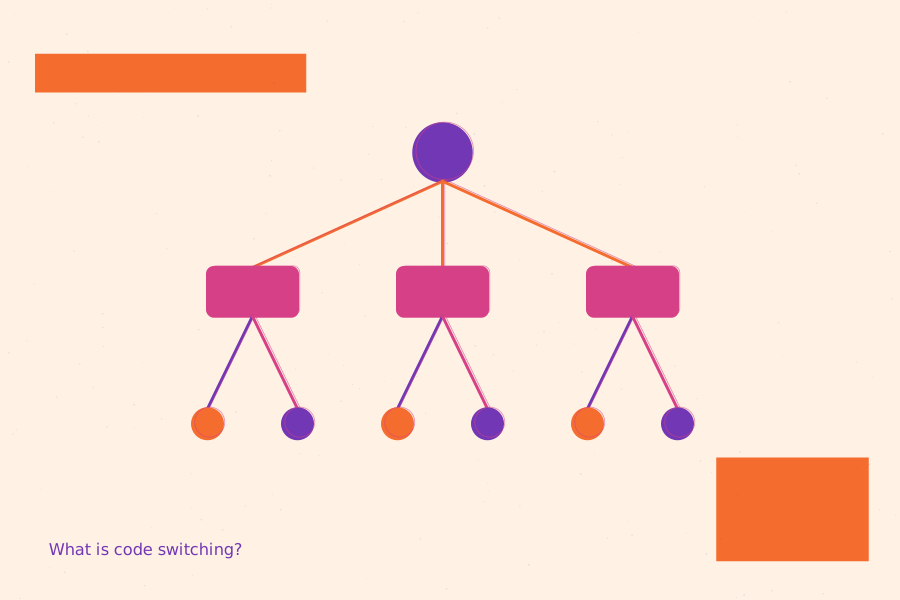
Code-switching is the use of more than one language or language variety during an interaction. A speaker might shift languages between sentences, move from one variety to another, or use a different form when addressing a new listener. The switch can reflect audience, topic, setting, or a conversational purpose; it does not by itself show that the speaker is confused. Language variation is shaped by social context, and sociolinguistic research examines language in use. [1]
What changes at the switch
The word “code” can refer to a language or variety that speakers draw on. A switch may happen between turns, clauses, or phrases, depending on the speaker’s repertoire and the interaction. It can also occur when someone quotes another person or uses a familiar expression from a different language.
The textbook describes sociolinguistics as studying the relationship between language use and context, including how variation can convey social information. That framework helps explain why a shift can do more than exchange vocabulary: it can mark a change in audience, topic, stance, or shared reference. [1]
An invented conversation
Consider this clearly invented example between two bilingual coworkers who share English and Spanish. One says in English, “The schedule changed again.” After noticing that a colleague who joined the conversation also speaks Spanish, the first speaker adds, “Te mando la nueva versión esta tarde,” meaning “I’ll send you the new version this afternoon.” The shift may make the offer feel direct and accessible to both participants.
This example does not establish a universal reason for switching. The speaker could have chosen Spanish because it felt easier for that promise, because the colleague had used Spanish first, or for another reason. To interpret the move, consider the sequence of turns and the participants’ shared knowledge rather than assigning a motive from one phrase alone.
Switching can manage relationships
A person may use one language with family and another in a workplace, or shift when a new participant joins. A speaker may also use a particular variety to quote someone, create humor, signal solidarity, or distinguish a formal explanation from a personal aside. These are possible functions, not a checklist that applies to every conversation.
People often adapt language to listeners, but the adaptation is not always conscious or deliberate. A shift can emerge naturally from the topic or from the words that come most readily in a moment. The relevant point is that multilingual speakers use the resources available to them in structured social settings.
Try an observation exercise
If you use more than one language or variety, keep a private note of three moments when you shifted. For each, record what changed, who was present, what topic was underway, and what happened immediately before and after the switch. Avoid recording other people without their consent.
Then compare the entries. Did a new participant arrive? Did the topic change? Were you quoting a phrase or speaking to someone with whom you share a particular language? Write down two possible explanations for each switch instead of settling on the first. This small practice helps separate what you observed from what you inferred.
Distinguish switching from learning difficulty
Using multiple languages is not a disorder, and a switch alone is not evidence of weak knowledge. In a conversation, speakers may select whichever language or variety fits the moment, and they may borrow familiar words or change languages to keep the interaction moving. Whether a particular utterance is described as code-switching can depend on how a researcher defines the term.
For listeners, a practical response is to follow the meaning and ask for clarification when needed. In a group where not everyone shares both languages, speakers can briefly translate or summarize a key point so everyone can participate. That supports the conversation without treating multilingual speech as a problem to eliminate.