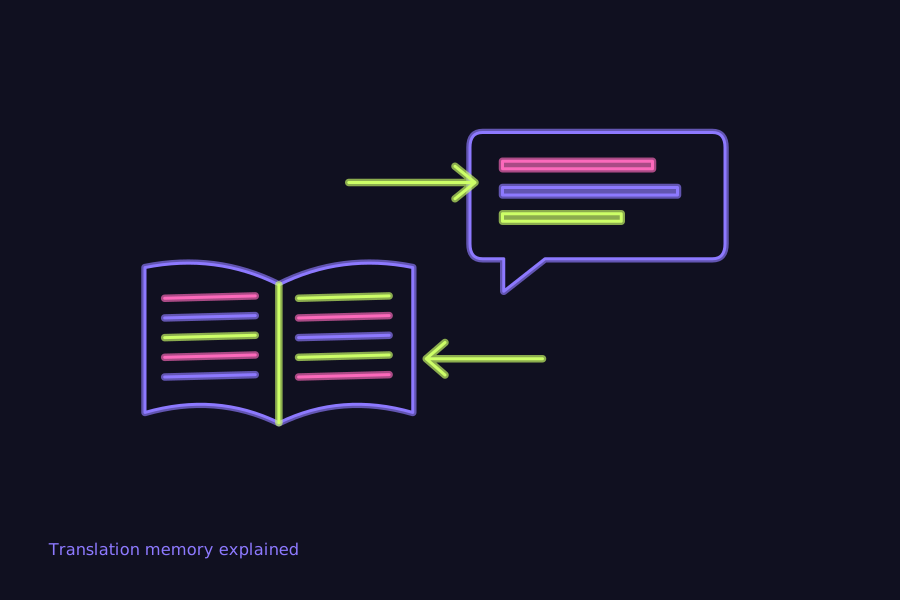
Translation memory is a tool that stores aligned source and translated segments so a translator can reuse earlier work. It is not a dictionary, a glossary, or a system that automatically understands a whole document. It compares a new segment with stored examples and offers a possible match; a person decides whether to accept, adapt or reject it.
What gets remembered
A translation memory, often shortened to TM, stores pairs such as a source sentence and its translation. A segment might be a sentence, heading, list item or other unit chosen by the project’s software and settings. The memory can also retain context such as file, subject area or date, depending on how it is managed.
Suppose a team translates “Select a delivery window” for a booking page. Later, a similar sentence appears in a confirmation email. The TM may retrieve the earlier translation. That gives the translator a starting point, especially if the wording is still appropriate and consistent with the product’s voice.
Matches are suggestions, not verdicts
A perfect or exact match indicates that the stored source segment matches the new one according to the system’s comparison. A fuzzy match is similar but not identical. For instance, “Select a delivery window” and “Select a delivery date” share much of their wording, but the changed noun affects meaning. The proposed translation needs review rather than blind reuse.
Even an exact match can be wrong in context. A short button label may appear in a different workflow; a sentence may refer to a different audience or object. Translators should check surrounding text, variables, punctuation, tone and whether the product has changed since the old translation was approved.
How it differs from related tools
A translation memory stores examples of translated segments. A terminology list stores preferred terms and guidance, such as how to render a product feature or whether a name should remain unchanged. A machine translation system generates proposed text from a model. These tools can appear together in a workflow, but they answer different questions: “What did we use before?”, “Which term should we use?” and “What wording might work here?”
The United Nations lists terminology among the work of language professionals, alongside translation and interpretation, reflecting that terminology is a distinct part of multilingual communication [1]. In a practical project, a term list might instruct a translator to keep a feature name in English, while the TM supplies a previously approved sentence that contains it.
A small worked review
Imagine a help center with the sentence “You can pause reminders at any time.” The TM retrieves a close match for a new sentence: “You can pause notifications at any time.” The translator should check whether reminders and notifications mean the same thing in this product. If not, preserve the useful sentence structure but choose the correct term. Then review the translated sentence for naturalness and confirm the change does not conflict with related screens.
If the team accepts the new version, it can be added to the memory so future work can reuse it. If the decision is temporary or specific to one campaign, the team may keep it out of a shared memory or label its context. Memory quality depends on the quality and relevance of what is saved.
Make reuse useful
Before a project, decide who can add, edit or retire entries and how the team will handle outdated text. Keep memories organized by subject, audience or product where that helps prevent unrelated matches. When reviewing a suggestion, consider meaning, context, current terminology, target-language naturalness and any variables or formatting.
Try a simple audit: choose ten frequently reused messages, compare their stored translations with the current product, and flag versions that are stale or ambiguous. This exercise can expose whether the memory is helping people work consistently or merely repeating old decisions.