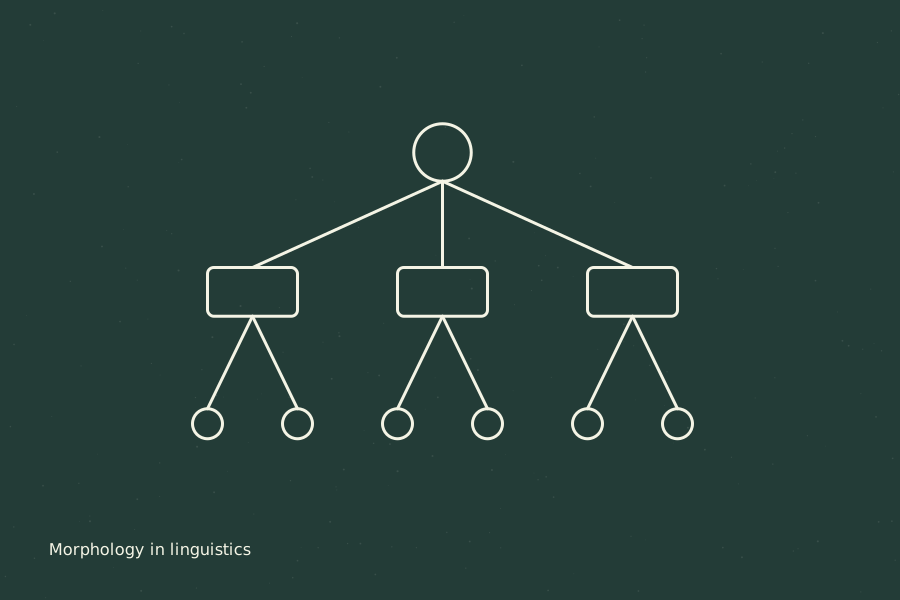
Morphology in linguistics is the study of how words are built from smaller parts. Those parts can contribute a recognizable meaning, such as “again,” or a grammatical job, such as marking more than one. Looking inside words helps explain why a sequence can be meaningful in one order but not another. [1]
Look inside the word
A word’s internal structure is not just a matter of spelling. Linguists ask whether speakers treat a form as containing recurring pieces that pair with meaning or grammatical function. A useful starting point is cats: cat names the animal, while the ending -s marks plural in this form. The two pieces combine in a particular order; reversing them does not produce the same plural word. [1]
The recurring pieces are called morphemes. Some can stand alone, like cat, while others attach to a base. An attached piece is an affix. A prefix goes before its base; a suffix follows it. A root is the central piece that carries the core lexical content, though a word can contain several layers around it. [1]
Three ways words gain structure
Inflection adds grammatical information without making a new dictionary word or changing the word’s basic category. In English, plural -s in cats and past-tense -ed in walked are familiar examples. The details differ across languages: grammatical information may be expressed through affixes, changes inside a stem, or other patterns. English examples are a starting point, not a template for every language.
Derivation forms a new word or changes its category. In kind, the suffix -ness creates the noun kindness; adding un- to kind creates unkind. Compounding joins bases, as in teacup or raincoat. These are broad types of word formation, and particular languages organize them in different ways. [1]
A worked analysis: reopens
Take the sentence, “After lunch, the library reopens.” Start with open, a verb meaning to make or become accessible. The prefix re- contributes a sense of doing again, so reopen is still a verb, with a modified meaning. The ending -s marks the present-tense form used with a third-person singular subject in this sentence. A practical segmentation is re- + open + -s.
This analysis asks what each piece contributes, not simply where letters appear. A sequence of letters does not count as a morpheme merely because it resembles a piece found elsewhere. For example, the -er in baker can form an agent noun from bake, but the ending in taller has a different grammatical role. You need evidence from recurring patterns and meaning or function. [1]
Use a small test
Choose a word you use often and make a short family of related forms: help, helpful, helpless, helper. Circle the part that recurs, then note what each added piece contributes. Ask whether the new form keeps the same category and basic lexical identity, adds grammatical information, or creates a related word. Check your first guess against how the forms behave in actual sentences.
Then try a word whose structure is less transparent. A word’s history does not automatically determine how speakers analyze it today. Someone may know that a form once contained pieces from an older language without treating those pieces as meaningful parts now. The linguistic question concerns a speaker’s present-day system, and speakers can differ in their analyses. [1]
Why the distinction matters
Morphology gives a way to describe the patterns that let speakers create, recognize, and interpret words. It also connects word structure to other parts of grammar: an ending can signal a grammatical contrast, while a derivational suffix can affect a word’s category and the kinds of sentence positions it can occupy. A careful analysis keeps these functions distinct instead of labeling every added sound “an ending.”
The next step is to collect several forms from one language or dialect, compare their recurring pieces, and write down both the form and its contribution. A small set of well-chosen examples usually reveals more than guessing from one long word.