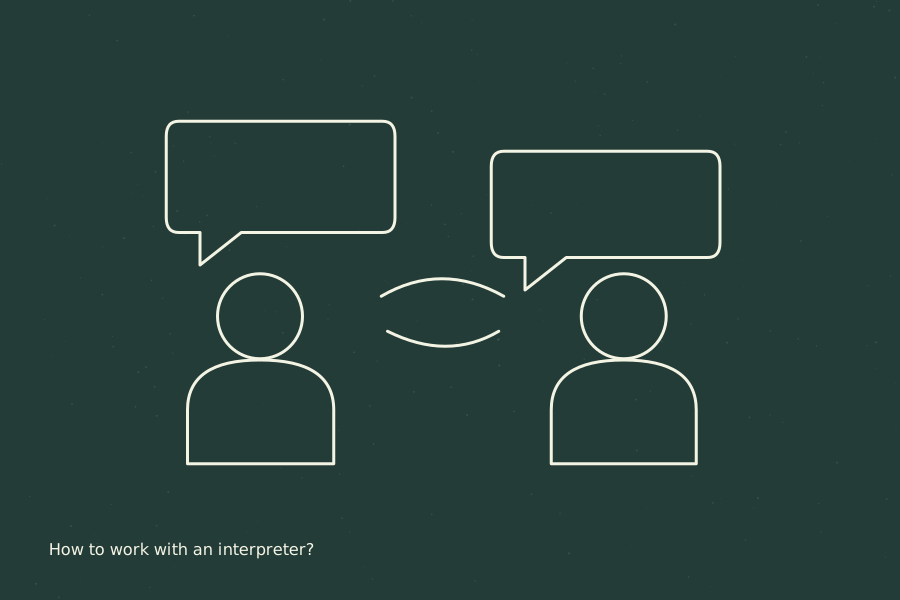
To work with an interpreter, speak directly to the person you are addressing, pause often enough for interpretation, and give the interpreter a clear briefing beforehand. Interpretation carries spoken meaning between languages in real time; the interpreter is not a substitute for either participant. The United Nations describes interpreters as one kind of language professional and notes that delegates’ speeches can be interpreted simultaneously between official languages [1]. That formal setting illustrates the basic task: people communicate through a professional who conveys what is said, rather than taking over the exchange.
Before the conversation, set the purpose
Tell the interpreter who will be present, what the conversation is for, how long it is expected to last, and whether you expect technical terms, sensitive topics, or documents. Share relevant names, acronyms, and written material in advance when possible. This gives the interpreter context for choices that might otherwise be ambiguous, such as whether “charge” means a fee, an accusation, or electrical power.
Agree on practical details: where people will sit, how participants will take turns, how to signal a pause, and whether interpretation will be consecutive or simultaneous. In consecutive interpreting, the speaker pauses while the interpreter renders a segment; in simultaneous interpreting, the interpreter works as speech continues. The right arrangement depends on the setting and available equipment. Do not assume every conversation calls for the same mode.
Speak to the person, not about the person
Use first and second person as you normally would: “What would make this plan workable for you?” Address the other participant, maintain ordinary eye contact where appropriate, and let the interpreter speak in the first person if that is the agreed convention. Avoid directing every sentence to the interpreter as though the other person has left the room.
Keep each turn focused. A few related sentences are easier to interpret than a long speech filled with side notes, nested explanations, and several questions. Speak at a natural pace and pause at a complete thought. Avoid stopping after every word or asking the interpreter to summarize; both can disrupt the exchange and blur who said what.
A worked example: clarify the next step
Imagine a community organizer and a resident discussing a repair visit through an interpreter. The organizer says, “We can send someone Thursday morning. Will you be home, and is there a buzzer we should use?” Then the organizer pauses. After the interpretation and answer, the organizer can confirm: “I heard that Friday afternoon is better. Is that right?” The interpreter conveys the exchange; the participants confirm the actual appointment.
Compare that with a long turn that combines the repair problem, the building’s history, a proposed schedule, and three questions. If a detail needs clarification, the interpreter or participant can request it before the conversation moves on. You can also repeat a date or spell a name, then ask the other person to confirm it. Those are communication checks, not tests of the interpreter.
When meaning is unclear, pause and repair it
If someone seems confused, stop the conversation and explain what you mean in different words. Do not ask the interpreter to silently fix a confusing instruction or infer missing context. For instance, instead of “We’ll close this out after the review,” say, “After the supervisor checks the repair, we will tell you whether more work is needed.” Plain language helps every participant.
Speak up if you think something was missed, but describe the issue neutrally: “Could we go back to the date?” or “I meant the entrance on Pine Street.” The interpreter can then convey the clarification. If a serious disagreement about meaning persists, pause and work out how to proceed rather than pressing ahead on uncertain information.
Close with a shared record
Before ending, recap decisions, responsibilities, dates, and unanswered questions in short statements. Ask each participant to confirm the points that matter. If written instructions follow, make sure they are available in a form the recipient can use; interpretation of a conversation does not itself translate a handout or create an accessible record.
A practical next step is to prepare a one-page briefing with names, purpose, specialized terms, and the decisions the conversation needs to reach. Keep it factual and concise. Then begin by inviting participants to correct names or context, and allow the interpreter to request clarification when needed.