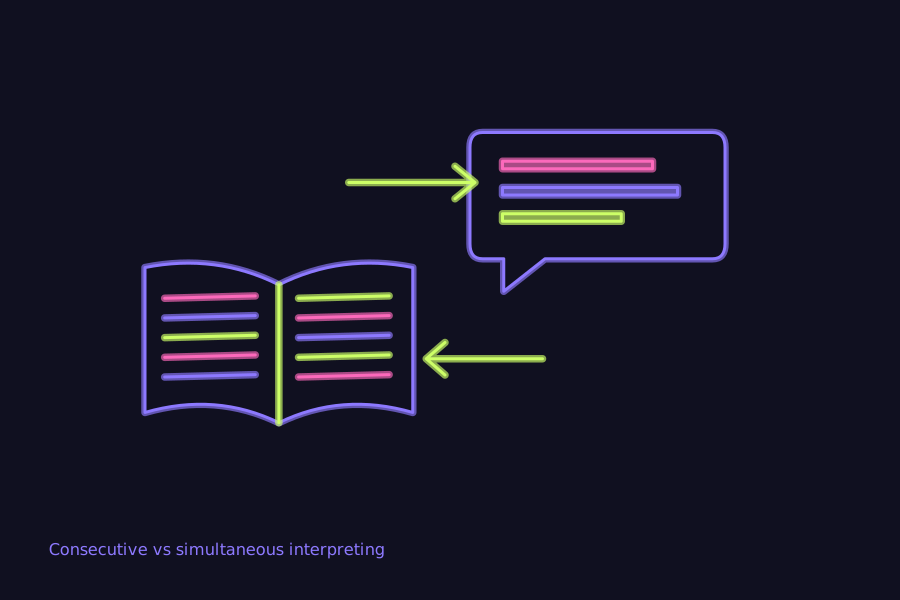
Consecutive interpreting happens in turns: the speaker delivers a segment, pauses, and the interpreter conveys it. Simultaneous interpreting happens as the speaker continues, with the interpreter speaking or signing at nearly the same time. The distinction is about timing and turn-taking, not about one mode being inherently more accurate. Interpreting is one of the language professions that helps people communicate across languages.[1]
The pause is the key difference
In consecutive mode, the speaker and interpreter alternate. The interpreter listens to a manageable stretch, retains its meaning, and renders it during a pause. The speaker may need to divide remarks into shorter segments, especially when details or conditions matter. This gives participants a clear opportunity to hear one version at a time.
In simultaneous mode, the interpreter works while the speaker carries on. Participants receive the interpretation with little delay, often through headsets or another arrangement that separates the interpreted voice from the original. In signed-language settings, the interpreter may work visibly in the room. The languages and access arrangements vary; there is no single universal gesture system.
An example: a community meeting
Imagine a meeting where a coordinator explains how residents can request a repair. With consecutive interpreting, the coordinator might say one step, pause, and let the interpreter render it before continuing. If the instruction includes a deadline and an exception, that pause can give participants time to follow the information and ask for clarification.
At a larger meeting with several speakers and a tightly scheduled agenda, simultaneous interpreting may let the presentation continue while listeners hear it in another language. That setup can reduce the wait between versions, but it requires suitable conditions, such as an agreed way for listeners to receive the interpretation and for interpreters to hear the speaker clearly. These are hypothetical examples, not accounts of real events.
Choose for the interaction
Consecutive can suit a short interview, a small group discussion, or a setting where speakers need direct turn-taking and no interpretation equipment is available. It can also help when each interpreted segment needs to be followed by a response. The tradeoff is time: each contribution is effectively delivered twice, and speakers need to allow space for interpretation.
Simultaneous can suit conferences, presentations, or proceedings where many people need interpretation without doubling every speaking turn. It asks more of the audio and room setup, and it can be harder to interrupt smoothly for a question. The best choice depends on the event’s size, pace, participants, language directions, and available arrangements—not on a simple ranking of the modes.
Make the session workable
For consecutive work, tell speakers to pause at complete ideas, speak at a measured pace, and avoid starting the next point while the interpreter is rendering the previous one. Provide names, acronyms, and written materials in advance when possible. Encourage participants to address one another directly and leave time for interpretation and questions.
For simultaneous work, plan how interpreters will hear the speaker and how participants will hear the interpretation. Confirm turn-taking, microphone use, and how to signal questions or a need to repeat something. Share the agenda and relevant terms ahead of time. Clear audio and predictable speaking turns support the work; a fast delivery packed with unexplained names can make either mode harder.
Try a short planning exercise
Write down the longest speaking turn, the number of people who need interpretation, whether participants must respond immediately, and what equipment or room arrangements exist. Then sketch the flow of one agenda item in each mode. In the consecutive sketch, mark pauses and time for replies. In the simultaneous sketch, mark how listeners receive the interpretation and how the speaker handles questions.
If either sketch leaves no room for a participant to understand, respond, or ask for clarification, adjust the agenda or arrangement. Share the plan with the interpreter before the event so practical questions can be resolved. This exercise does not replace professional advice about a particular setting, but it makes the timing consequences visible before people gather.